 Marrakech Guidebook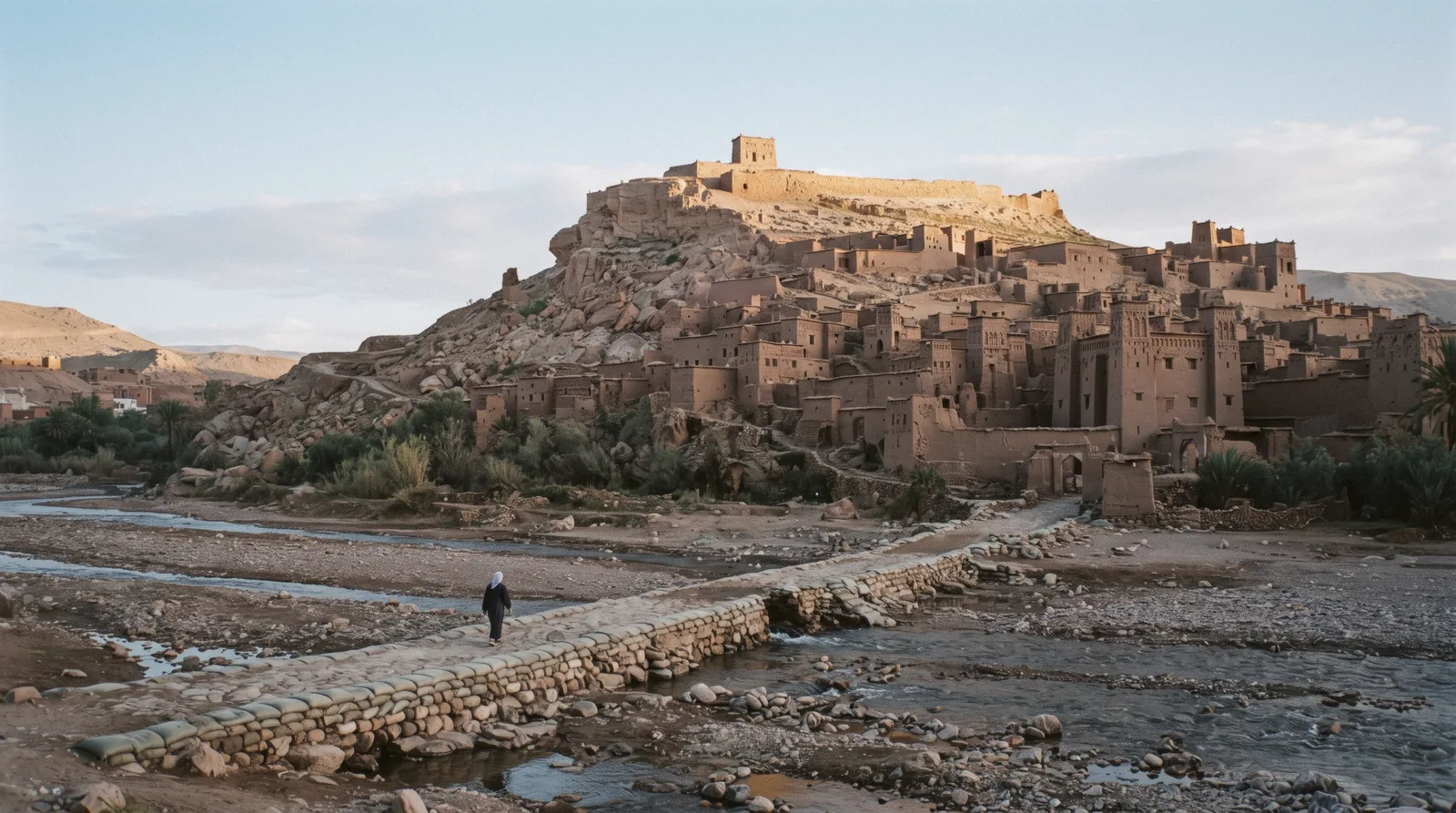
Ait Ben Haddou Day Trip from Marrakech
An Ait Ben Haddou day trip from Marrakech is a 10 to 12 hour round trip over the High Atlas to a World Heritage ksar of 3.03 hectares that no scheduled carrier actually serves. Coaches run four times a day to Ouarzazate, 30 km short of the site, at $11.72 (110 MAD) on one operator and $12.25 (115 MAD) on the other, and the last leg is on nobody's timetable. This page sets out that gap, what the ksar is, what UNESCO says about it and what it does not, and which of the two escorted days is the better buy. The other options out of the city sit on the day trips index. For the wider picture, see things to do in Marrakech.
Quick answer What it costs, how you get there, how long on site
No scheduled coach reaches Ait Ben Haddou. Supratours and CTM each run four a day to Ouarzazate, 30 km short, at $11.72 (110 MAD) and $12.25 (115 MAD), and no official page states any entrance fee for the ksar itself.
Key takeaways
- Two of Supratours' four returns from Ouarzazate leave at 01:00 and 01:15, so a public-transport day return is built on exactly two usable services; the timetable comparison sets out which
- The twelve-hour guided run to Ouarzazate and the ksar is the heaviest-reviewed product on this route, and the ten-hour version with Atlas Studios trades an hour of driving for a film-studio stop
- The one number everybody prints for Atlas Studios comes from no official source: the studio's own website has been dead since we started checking, which the film-studio section works through
Key facts
Opening hours
| Ksar, open village | 00:00–24:00 |
|---|---|
| Supratours coaches, Marrakech to Ouarzazate | 08:00–15:30 |
| CTM coaches, Marrakech to Ouarzazate | 00:30–16:15 |
Closed None published. The ksar is an inhabited village with houses, shops and no gate
Admission
- Adult
- Not stated. No official page publishes an entry fee for the ksar or the footbridge
- Reduced
- Not stated by any authority
- Free
- The village lanes, the riverbed crossing and the climb to the agadir at the top, as far as any published source says
Planning it
- Time needed
- Not stated by any authority. Our routing: 1 h 30 to 2 h on site, against about 7 h of driving
- Book ahead
- Recommended — a few days
- Address
- Ksar of Ait-Ben-Haddou, Ounila Valley, Ouarzazate Province, Draa-Tafilalet, Morocco
There is no admission to compare here, so this table compares the ways of covering the road. Coach fares were read in Supratours' and CTM's own booking systems in Q3 2026; the tour prices are the listed figures on GetYourGuide the same day. The two official rows link to the carriers with no tracking on them.
Are you paying to reach Ouarzazate, or to reach the ksar itself?
| Option | Price | Journey | Reaches | Book |
|---|---|---|---|---|
| Supratours coach to OuarzazateIndependent travellers staying a night in Ouarzazate rather than turning round | $11.72 (110 MAD) one way | 3 h 55 to 4 h 20, four a day | Ouarzazate only, 30 km short of the ksar | Official site |
| CTM coach to OuarzazateAnyone whose dates suit the 10:15 or 11:30, which Supratours does not match | $12.25 (115 MAD) one way | 4 h 15 to 4 h 45, four a day | Ouarzazate only; the ksar is on no CTM route | Official site |
| Guided day trip, Ouarzazate and the ksarFirst-timers who want the ksar and the pass with a guide and no connection to solve | From $25 | 12 h door to door | The ksar itself, with hotel pickup | Check Availability |
| Day trip with the Atlas Studios stopVisitors who came for the film history and accept a shorter stop at the ksar | From $27.53 | 10 h door to door | The ksar, Ouarzazate and the studios | Check Availability |
The gap this table exists to show is the last 30 km. Both carriers stop at Ouarzazate, the ksar is in neither the 177-station Supratours network nor CTM's 119-city network, and no official source documents a scheduled service, a fare or a frequency on that final leg. On the escorted days the leg is included and invisible; done alone it is a negotiation at the Ouarzazate rank with no published tariff behind it, which is why the two tour rows are here rather than as an upsell.
The Two Ait Ben Haddou Day Trips, Compared
Both are round trips from Marrakech with hotel pickup over the Tizi n'Tichka pass, and both include the last 30 km that no coach covers. Listed prices; the operator's page shows what is open on your date.
 from $25
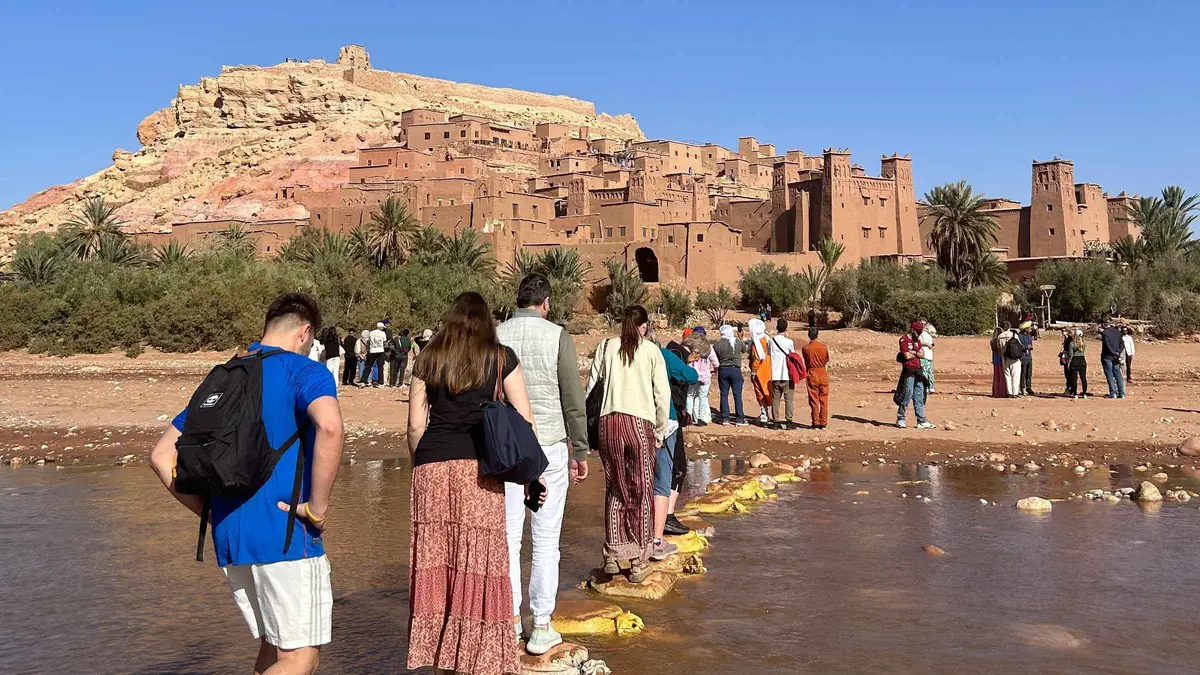
From Marrakech: Ouarzazate & Ait Benhaddou Guided Day Trip
listed at $25
Twelve-hour guided run to Ait Ben Haddou and Ouarzazate; the Atlas Studios stop is optional and run by the municipality's own guides. The heaviest-reviewed product on this route.
Check Availability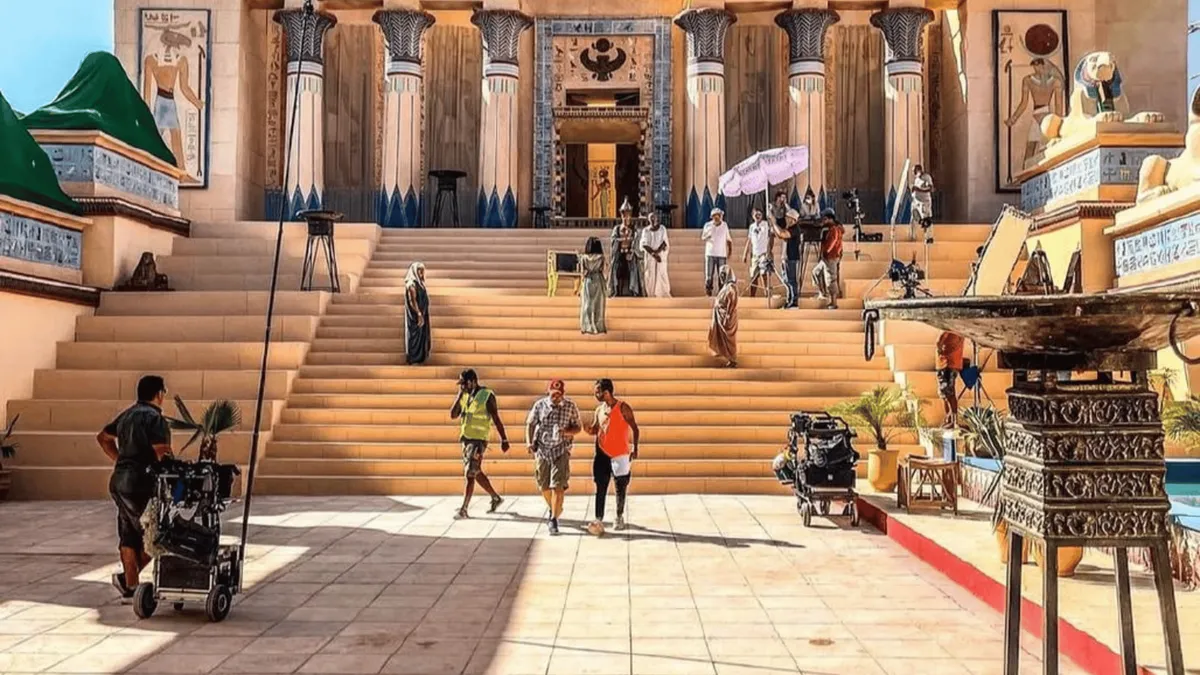 from $27.53
From Marrakech: Ouarzazate, Ait Ben Haddou & Atlas Studios
listed at $27.53
Ten to eleven-hour crossing of the Tizi n'Tichka to Ait Ben Haddou and Ouarzazate, with about three hours' driving each way. Pickup starts between 07:15 and 08:00.
Check AvailabilityPrices, ratings and details are the platform's own. Dollar figures are the listed prices. The platform bills in your account's currency.
What the Ksar Is, and What UNESCO Actually Says
A ksar is a fortified village of packed earth. This one is the most famous of them, and the World Heritage file on it is unusually specific about what it contains and unusually blunt about what threatens it.
The most famous ksar in the Ounila Valley
UNESCO inscribed the Ksar of Ait-Ben-Haddou in 1987 under criteria (iv) and (v), dossier 444, over a property of 3.03 hectares with a buffer zone of 16.32 hectares. The citation places it "in the foothills on the southern slopes of the High Atlas in the Province of Ouarzazate" and calls it "the most famous ksar in the Ounila Valley".
On the age, the file is careful in a way the guidebooks are not: "The oldest constructions do not appear to be earlier than the 17th century, although their structure and technique were propagated from a very early period in the valleys of southern Morocco." So the building method is old and the buildings are not. Anyone telling you the towers you are photographing are a thousand years old is telling you something the World Heritage file declines to say. Once you know what the ksar actually is, the next step is choosing among tours in Marrakech that make the drive over the Atlas worth it.
What is inside the walls
UNESCO lists the communal parts by name: "a mosque, a public square, grain threshing areas outside the ramparts, a fortification and a loft at the top of the village, an caravanserai, two cemeteries (Muslim and Jewish) and the Sanctuary of the Saint Sidi Ali or Amer".
That list is a better route plan than most itineraries. The threshing floors are outside the wall on the flat, the caravanserai and the square are in the lower village, the two cemeteries sit apart from each other, and the fortified granary at the summit is the point of the climb. The reason the village looks stacked is that it is: houses at the bottom, defence and storage at the top.
A trading post between Marrakech and the desert
The file explains why a village stands here at all: it was "one of the many trading posts on the commercial route linking ancient Sudan to Marrakesh by the Dra Valley and the Tizi-n'Telouet Pass". Marrakech is the northern end of that road, which is the historical reason the day trip exists and not simply a tourism convenience. You are travelling a caravan route in reverse, in four hours instead of days.
The modern crossing takes the Tizi n'Tichka rather than the Telouet pass the caravans used, and the older route past the Telouet kasbah is still driveable. No official road authority publishes the state of either, for the reason set out lower down this page.
Getting There: Four Coaches to Ouarzazate, None to the Ksar
This is the day trip where the do-it-yourself route breaks, and it breaks in a specific and checkable way. Every figure below came out of the two carriers' own booking systems. Start with what does not exist: there is no train. Marrakech is the southern terminus of the rail network, and every Marrakech to Ouarzazate service the national rail operator sells sits in its own system under the coach range rather than a rail one, so the question is only ever which coach.
Both operators run four coaches a day each way between Marrakech and Ouarzazate, at fares eight cents apart, over a road that takes between 3 h 55 and 4 h 45 depending on the service. The departure times are the reason to read the grid rather than the price.
| Carrier | Marrakech to Ouarzazate | Ouarzazate to Marrakech | Fare one way | Journey |
|---|---|---|---|---|
| Supratours | 08:00, 13:00, 15:00, 15:30 | 01:00, 01:15, 08:45, 15:30 | $11.72 (110 MAD) | 3 h 55 to 4 h 20 |
| CTM | 00:30, 10:15, 11:30, 16:15 | 08:30, 10:00, 12:00, 22:45 | $12.25 (115 MAD) | 4 h 15 to 4 h 45 |
Read the return column, not the fare
Two of Supratours' four returns leave Ouarzazate at 01:00 and 01:15. That is not a typo and it is not unusual on Moroccan long-distance routes, but it means the operator's four daily services collapse to two that a day visitor can use: the 08:45 and the 15:30. Pair the 08:00 out with the 15:30 back and you have arrived at 12:14 and must be back at the terminal by 15:15, which leaves three hours in Ouarzazate and no realistic run to the ksar and back.
CTM's returns are friendlier at 08:30, 10:00 and 12:00, but its earliest usable departure from Marrakech is the 10:15 arriving 15:00. A same-day return on public transport is therefore not a comfortable day out. It is a puzzle with two pieces that do not fit, and the honest recommendation is either an escorted day or a night in Ouarzazate.
The last 30 km nobody timetables
The ksar is not in the Supratours 177-station network and not in CTM's 119-city network. No official carrier or transport authority publishes a scheduled service, a fare or a frequency between Ouarzazate and Ait Ben Haddou. What exists on the ground is grand taxis and local arrangement, and since no Moroccan authority publishes a grand-taxi tariff for this route either, any figure you read for it is somebody's memory of what they paid.
We do not print one. The getting-around page explains why the same silence covers taxi pricing across the whole region.
The pass, and why no road numbers are listed here
The road crosses the Tizi n'Tichka, and the operators themselves note that snow can close it in winter. That is worth planning around between December and February; it is also the only claim about the road we can support. The Moroccan equipment ministry's domain has no DNS record reachable from outside the country, so the upgrade programme on the trunk road, the tunnel project and any current closure could not be verified from any official page.
So this page prints no road number and no kilometre figure for the drive, only the scheduled running times above, which come from carriers who have to honour them.
On Site: The Climb, the River and the Two Crossings
Nothing here is ticketed as far as any published source states, and the walk is short but steep. This is what the hour and a half on the ground actually involves.
Crossing the riverbed
The modern village, the cafes and the coach parking sit on the near bank of the Ounila; the ksar is on the far one. In dry months the bed is walkable and there are sandbag stepping stones; there is also a footbridge. No official page states a fee for either crossing, and the ksar has no ticket office, no published hours and no closing day.
A charge asked of you at the crossing or at a house door is a private arrangement, not a state tariff, and knowing that is worth more than a number would be.
The climb to the agadir
From the bed to the fortified granary at the summit is a continuous climb through the village lanes, past houses that are lived in and houses that are shops. Allow forty minutes up at a steady pace with photographs, twenty back down. There is no shade on the upper half and the earth reflects heat, which is why one of the operators on this page warns that the ksar is fully exposed at midday. In July and August, that is the single biggest comfort factor of the whole day.
The view from the top is south over the palm groves and the modern village, and north up the Ounila valley towards Telouet. It is what the climb is for.
Why it is still standing, and what threatens it
The World Heritage file names the threat plainly, and it is not the one people assume: "The earthen buildings are very vulnerable due to lack of maintenance and regular repair resulting from the abandonment of the ksar by its inhabitants." Depopulation, not tourism. The same text says CERKAS, the conservation body for the Atlas and sub-Atlas zones, "monitors, with difficulty, respect for the visual integrity of the property".
On cement, the file is almost wry: "The inclination to introduce cement has so far been unsuccessful, thanks to the continued monitoring of the Comite de controle des infractions. Only a few lintels and reinforced concrete escaped its vigilance, but they have been hidden by earthen rendering." Look for the rendering that is slightly too smooth and you have found the concrete.
Ouarzazate and the Film Studios: What Can and Cannot Be Sourced
Half the trips on this route sell a studio stop, and the studio has no working website. The gap between what is advertised and what is documented is worth a paragraph before you pay for it.
The number everyone prints, and where it is not from
Atlas Studios is quoted everywhere at a fixed entry price with opening from the morning to sunset, but neither figure is confirmed by an official source.
So the price that appears in every guide is third-party only. Treat it as a plausible amount to have in cash, not a published tariff, and note that on the guided day with the studio stop the entry is listed as extra rather than included.
What the national tourist office does say
The official destination page for Ouarzazate names the industry rather than the ticket: it lists David Lean, Ridley Scott, Martin Scorsese and Alejandro Gonzalez Inarritu among the directors who have worked here, and Lawrence of Arabia, Gladiator, Kundun and Babel among the productions. It gives no fees, no hours and no mention of the Taourirt Kasbah in the town.
That is the whole official record of film tourism in Ouarzazate. If the studios are the reason you are making the trip, book the version of the day that includes the stop and carry cash; if the ksar is the reason, the ten-hour trip with the studios in it gives you less time on the climb.
How Much Time to Give Ait Ben Haddou
How long to spend in Ait Ben Haddou is really a question about the road: about seven hours of the day is driving whatever you choose, so the routing question is what the remaining three or four hours do. These are the three shapes, with what each gives up, and they are also the answer to whether the ksar is worth visiting at all, because the verdict turns entirely on how much time you buy at the top of it.
The time on site is our estimate from the walk itself: the climb from the riverbed to the granary and back is under an hour and a half at a steady pace, and the lower village absorbs whatever is left. Driving times are the operators' own stated durations and the carriers' scheduled running times.
| Routing | On the ground | What it covers | What it gives up |
|---|---|---|---|
| Ten-hour trip with the studios | About 1 h at the ksar | The pass, the ksar from below, the film studios | The climb to the granary at any comfortable pace |
| Twelve-hour guided day | About 2 h at the ksar | The climb, the lanes, the caravanserai, Ouarzazate | An early return to Marrakech; you are back after dark |
| Coach to Ouarzazate, night there | A full morning | The ksar before the coaches, the Taourirt kasbah, the valley | A day of the Marrakech trip, and the fare each way |
Our pick, and why
The twelve-hour guided day. It is the only version of this trip that puts you at the top of the ksar with time to look at it, and on the route where public transport genuinely does not close the loop, the escorted day is not the lazy option but the working one.
Take the overnight instead if the ksar is a reason you came to Morocco rather than a box on a list. The site at eight in the morning, before the day coaches cross the pass, is a different place from the site at one in the afternoon, and Ouarzazate has the accommodation to make that easy. What we would not do is the ten-hour version if the ksar is the point; an hour on the ground after seven hours in a vehicle is a photograph, not a visit.
At The Ksar: What To Do, And What Not To
Each line is a decision argued above, in the form you can act on the morning you go.
Do
- Climb to the fortified granary at the top, since the summit is what the World Heritage file singles out and what the lower village hides
- Carry cash in small notes for the crossing, a mint tea and anything asked at a house door, because none of it is a published tariff
- Start the climb early or late in the day; the earth reflects heat and there is no shade above the halfway point
- Ask your operator whether the studio entry is included before you assume it is, since the studio stop is listed as extra on both trips
- Check the pass in winter, since the operators themselves warn that snow can close it
Don't
- Don't plan a same-day public-transport return, because two of the four Supratours departures back leave at 01:00 and 01:15
- Don't expect a ticket office; no authority publishes an entry fee, hours or a closing day for the ksar
- Don't repeat the thousand-year-old line, since the World Heritage file dates the oldest constructions to the seventeenth century
- Don't book the ten-hour trip if the climb is the reason you are going, as it leaves about an hour at the site
- Don't count on a fixed price for the last 30 km from Ouarzazate, which no carrier and no authority timetables or prices
Five Things Most Visitors Do Not Know
Every bullet ends in the source it came from, because a claim about a Moroccan fee or a heritage rule is worth what its source is worth.
- The World Heritage file dates the oldest surviving constructions to no earlier than the seventeenth century, not to the caravan era the village belongs to (UNESCO dossier 444).
- The stated threat to the property is depopulation and lack of maintenance, not visitor pressure; the file says so in those words (UNESCO dossier 444).
- The management plan UNESCO cites ran from 2007 to 2012, and no successor plan is named on the page (UNESCO dossier 444).
- CERKAS, the conservation body UNESCO itself links to for this site, has a website with no DNS record.
- Neither carrier serves the ksar: it is absent from the 177-station Supratours network and from CTM's 119-city network (both operators' own systems).
Ait Ben Haddou Map: The Ksar, Ouarzazate and the Pass
The site, the coach terminal 30 km away that is as close as scheduled transport gets, and the pass the road crosses. Terminal coordinates are from the carrier's own station list.
Coordinates for the ksar and the pass from the World Heritage record and Wikidata; terminal coordinates from the carrier's station list.
The Other Long Days Out, Against This One
Ait Ben Haddou is the longest day trip on this site that still gets you home. Durations are the operators' own stated figures and the carriers' scheduled running times.
Essaouira
The same length of day, but with seven coaches a day at the far end and no last-mile problem. Essaouira is the day trip you can genuinely do alone.
3 h each way, scheduledOuzoud Falls
Also unreachable on a scheduled service, for a different reason: neither carrier serves the falls, Azilal or Demnate at all. Ouzoud has the arithmetic.
10 to 12 h door to doorMerzouga and Erg Chebbi
The dunes people mistake for a day trip. The only itinerary the national operator will sell takes 15 h 25 and arrives the next morning, which the Merzouga page proves from the timetable.
Three days, not oneAit Ben Haddou Questions
Is there an entrance fee for the ksar of Ait Ben Haddou?
No official tariff is published for the ksar, its inner kasbahs or the footbridge, and the conservation body UNESCO links to has no working website. Money asked at the river crossing or at a house door is a private arrangement rather than a state charge, so carry small notes and treat any figure online as unofficial.
Can you get to Ait Ben Haddou from Marrakech by bus?
Only as far as Ouarzazate. Both carriers run four coaches a day there, at $11.72 (110 MAD) and $12.25 (115 MAD), and the ksar is 30 km beyond the terminal with no scheduled service on that leg. Two of the four Supratours returns also leave at 01:00 and 01:15, which is why the fare table recommends either the escorted day or a night in Ouarzazate.
How long does the drive from Marrakech take?
The scheduled coaches run 3 h 55 to 4 h 20 on Supratours and 4 h 15 to 4 h 45 on CTM, over the Tizi n'Tichka. The escorted trips state about three hours each way to the ksar, which is a shorter run because they do not stop at every intermediate town. Door to door, the guided day is listed at twelve hours and the version with the studios at ten.
How old is the ksar, really?
The World Heritage file says the oldest constructions "do not appear to be earlier than the 17th century", while noting that the building technique itself spread through southern Morocco much earlier. The site's importance is as a trading post on the route linking the Sahara to Marrakech, which the same file describes; the earth architecture is repaired and rebuilt continuously, which is why an exact age is the wrong question.
Is Atlas Studios worth adding to the day?
Only if film history is why you are going. Neither the entry price nor the opening hours can be sourced from any official page, since the studio's own domain is dead and the relevant ministries are unreachable, and the entry is listed as extra on the trip that includes the stop. Adding it also costs you time on the ksar climb, which is the part nobody regrets.
When is the pass likely to be closed?
Both tour cards on this page carry the operators' own note that snow can close the Tizi n'Tichka in winter, and no Moroccan road authority page is reachable from outside the country to confirm closures. Travelling between December and February, ask the operator the night before and keep a city day in reserve.
Where This Day Fits in a Marrakech Trip
This is a day four trip at the earliest, and the one day out where the escorted version is worth paying for. On every other route in this guide the do-it-yourself option is a real alternative with a published fare and a usable return, but here the timetable does not close.
It also pairs badly with anything else. The pass takes the morning, the ksar the middle of the day, and the return the evening, so there is no version of the day that leaves a useful hour in Marrakech at either end. Plan the day before and the day after accordingly, and if the trip is only three days long, take the Atlas or the Ourika valley instead and leave the ksar for a trip with room for it.
Ait Ben Haddou On Film: The Climb, The Valley And The Sets
Three films of the site that show what the seven hours of road actually buy: the crossing, the lanes, and the view from the granary at the top.
Exploring Ait Ben Haddou: The Ancient Moroccan Village That Inspired Game of Thrones
A full walk-through of the village and the climb, filmed at ground level.
Video: The Roving BalysAit Benhaddou, An Incredible Fortified Village | Ouarzazate, Morocco
The ksar and the town of Ouarzazate together, which is the shape of the escorted day.
Video: Peter and YenAit Ben Haddou in Morocco: entrance, things to do on site and Telouet Kasbah
Covers the crossing, the site itself and the older Telouet route over the mountains.
Video: Travel smarter with SebVideos load from YouTube only when you press play.
Prices, hours and terms are set by the venue or operator and confirmed at checkout.
We may earn a commission if you book through one of our links, at no extra cost to you. Full affiliate disclosure