 Marrakech Guidebook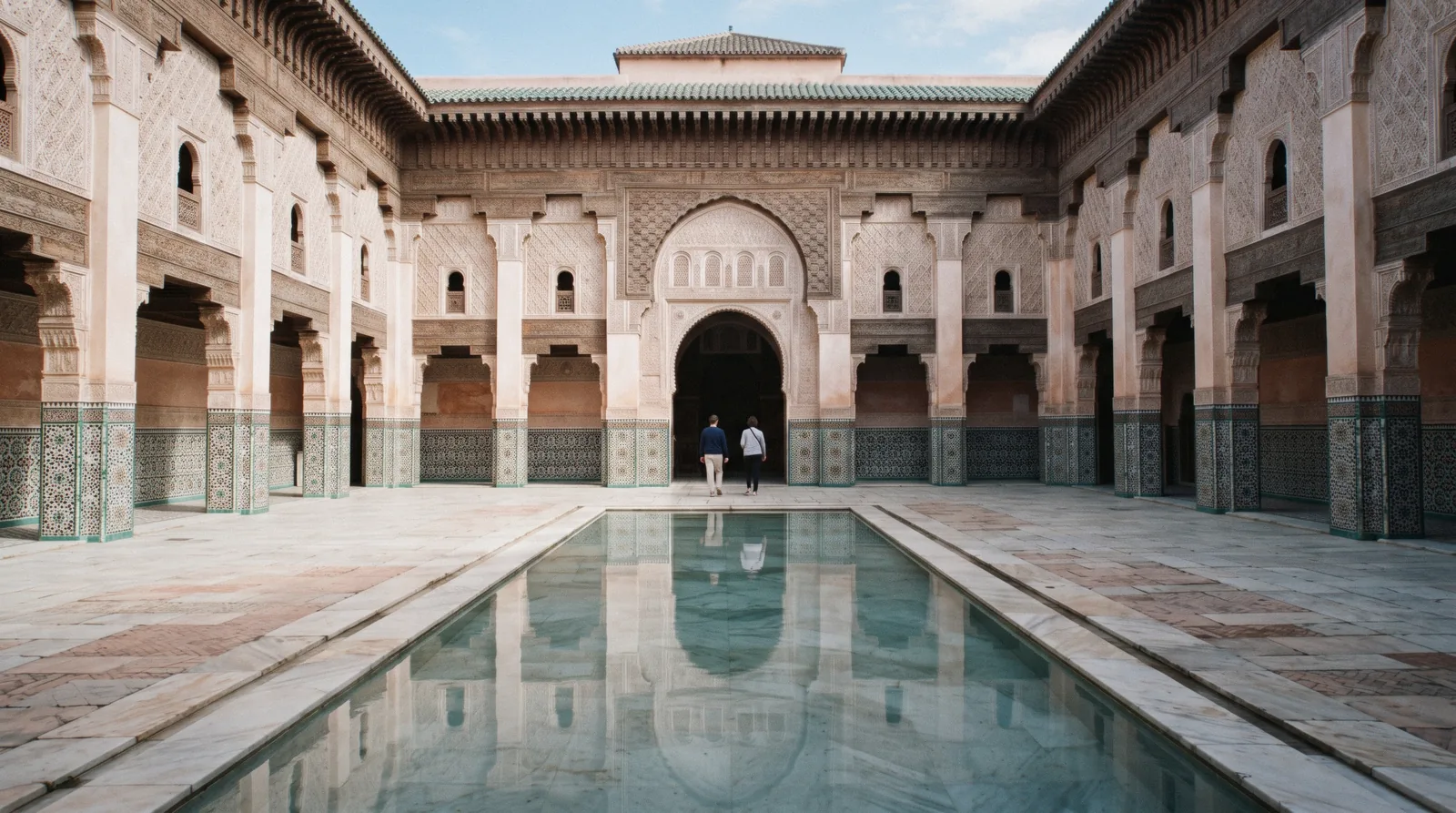
Ben Youssef Madrasa
The Ben Youssef Madrasa is the sixteenth-century Quranic college at the top of the souks, built around a courtyard pool with 130 student cells stacked around it, and the largest madrasa the Maghreb ever had. This page covers the hours, who may enter and why, what the rooms are, how long the visit takes and how it fits the northern medina; the fares and the ways to pay sit on the Ben Youssef Madrasa tickets page, and the monument opposite has its own Almoravid Koubba guide. For how this fits into two or three days, start at things to do in marrakech.
Quick answer Hours, who may enter, how long, what it costs
The Ben Youssef Madrasa opens every day 09:00 to 19:00, and 09:00 to 16:30 in Ramadan, with a foreign adult paying $5.33 (50 MAD) at the entrance. It is a former Quranic school rather than a working mosque, so it is open to everyone, and there are no timed slots.
Key takeaways
- It answers to the Ministry of Habous and Islamic Affairs, not the Ministry of Culture, so it is not sold on the platform that handles Bahia and El Badi and it costs half their fare; the full tariff and the ways to pay sit on their own page
- Give it 45 minutes to an hour: one courtyard, a prayer hall, an ablutions chamber and 130 student cells over two floors, of which a handful are open to walk into
- The four-hour walk with Bahia Palace and the Secret Garden version both put a licensed guide in the courtyard, with the 50 MAD entry paid at the door; the Almoravid Koubba is directly opposite and on a different tariff again
Key facts
Opening hours
| Every day, normal period | 09:00–19:00 |
|---|---|
| Ramadan | 09:00–16:30 |
Closed None published. The official site states no weekly closing day
Admission
- Adult
- $5.33 (50 MAD) foreign adult
- Reduced
- $2.13 (20 MAD) Moroccan adults on presentation of ID; $3.20 (30 MAD) per person in groups of 21 or more
- Free
- Not stated. The monument publishes no free category and no disability rate
Planning it
- Time needed
- Not stated by the monument; our routing: 45 minutes to an hour, and 30 minutes if you only want the courtyard
- Book ahead
- Optional — walk-up usually fine
- Address
- Rue Assouel, Marrakech 40000, beside the Ben Youssef Mosque in the northern medina
Three ways in, priced from the monument's own site and from GetYourGuide in Q3 2026. The madrasa is not on the Ministry of Culture platform and sells nothing in advance while its online system is down, so the official row is a cash transaction at the entrance; the tour rows add a guide and a route, never a cheaper entry.
Do you want to walk in on your own for the price of a coffee, or pay a guide who can read the inscriptions?
| Option | Price | Includes | Cancel | Book |
|---|---|---|---|---|
| Entrance ticket, bought at the doorEveryone who is comfortable with cash and a short queue; there is no online sale to compare it against | $5.33 (50 MAD) adult; $1.07 (10 MAD) under 12 | Entry to the courtyard, prayer hall, ablutions chamber and open cells | Not applicable | Official site |
| Guided walk: Bahia Palace, the madrasa and the medina, 4 hA first day in the city: it pairs the madrasa with the biggest palace, so add $5.33 (50 MAD) here and $10.65 (100 MAD) at Bahia | From $17.58 | Licensed guide, medina and souks route; entries paid at each gate | Free up to 24 hours before | Check Availability |
| Guided walk: the madrasa, Le Jardin Secret and the medina, 3.5 to 4 hAnyone staying in the northern medina: both stops are within ten minutes of the courtyard, plus $5.33 and $10.65 in gate fees | From $17.58 | Licensed guide, both monuments approached on foot through the souks | Free up to 24 hours before | Check Availability |
The gate fee is the cheap part and the guided walks say so themselves: both listings state that entrance fees are excluded and payable on site in cash. Two adults walking in unaided pay $10.65 (100 MAD) for the pair. The same two on the Bahia walk pay about $35.16 for the guiding and then $32.00 (300 MAD) in entries. Listed platform prices move with the date, so treat the card figure as final only at checkout.
Guided walks that include the Ben Youssef Madrasa
No operator sells a standalone ticket for this monument, because the monument sells its own at the door and nothing is timed. What the platforms sell is the guiding, and both cards below put a licensed guide in the courtyard and then take you somewhere else on the same walk. Prices as listed.
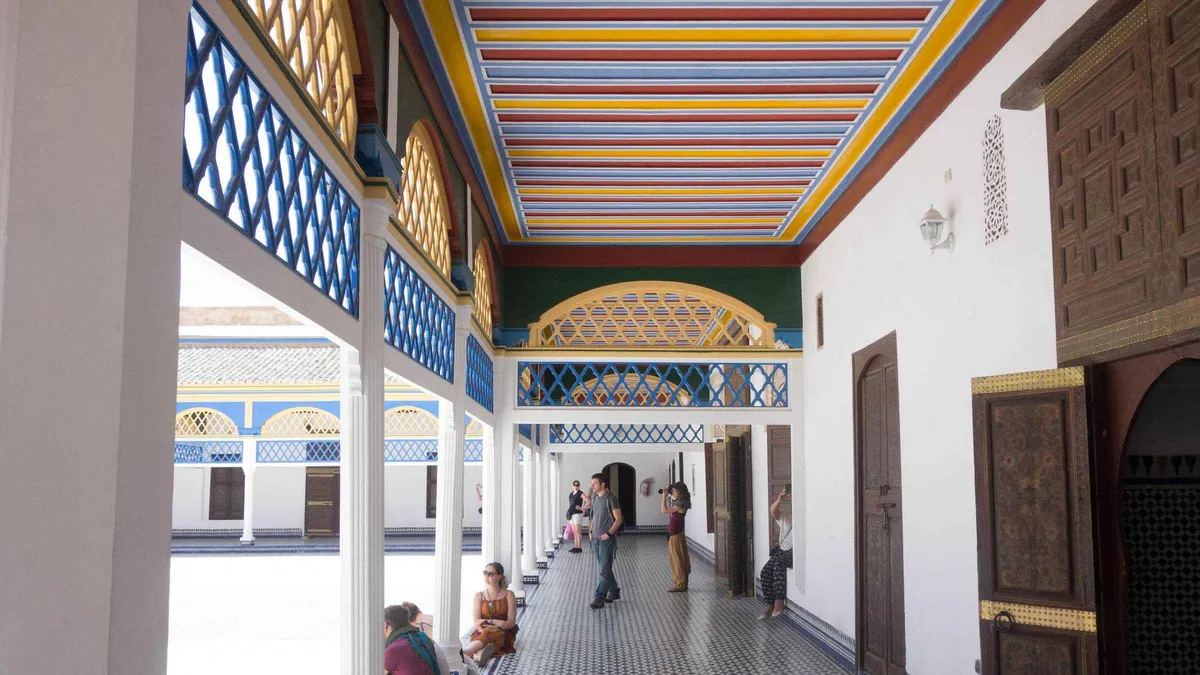 from $17.58
Marrakech: Bahia Palace, Madrasa Ben Youssef and Medina Tour
listed at $17.58
Four-hour guided walk through Bahia Palace, Madrasa Ben Youssef and the medina with a licensed guide. Entry is paid in cash at the door: 100 MAD for Bahia Palace and 50 MAD for the madrasa.
Check Availability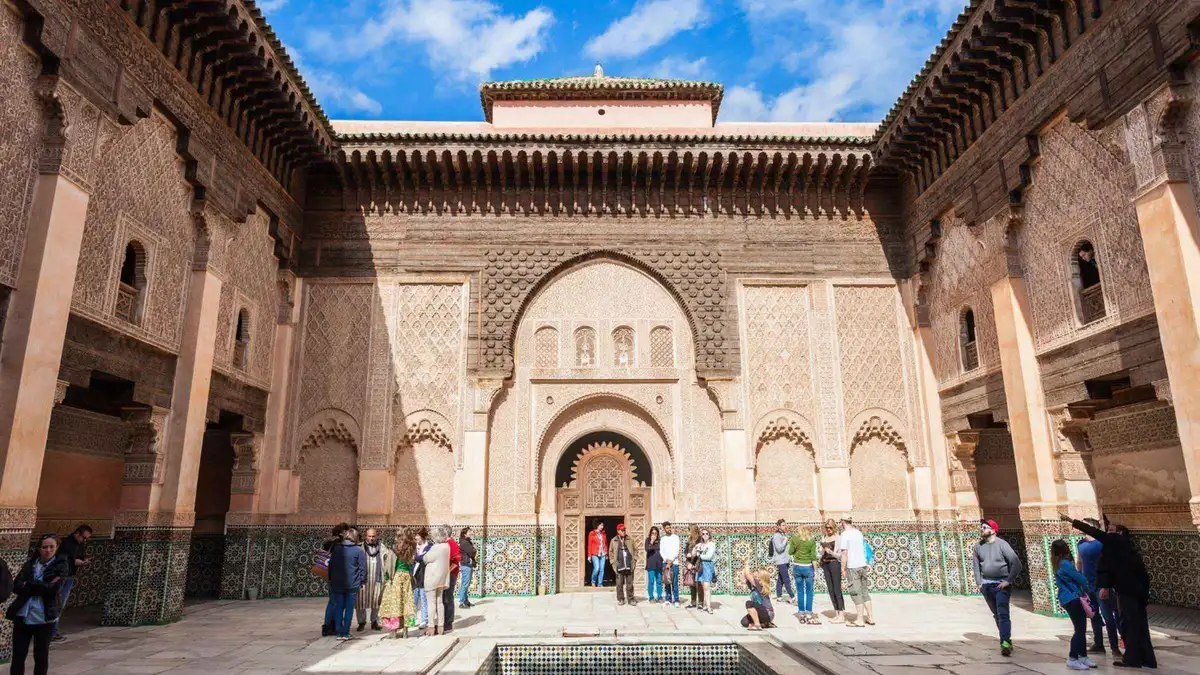 from $17.58
Marrakech: Madrassa Ben Youssef, Secret Garden & Medina Tour
listed at $17.58
Three-and-a-half to four-hour guided walk covering Madrasa Ben Youssef, Le Jardin Secret and the medina. Gate fees are separate and in cash: 50 MAD for the madrasa, 100 MAD for the garden.
Check AvailabilityPrices, ratings and details are the platform's own. Dollar figures are the listed prices. The platform bills in your account's currency.
What The Madrasa Is, And Who Runs It
Two facts do most of the work on this page: what the building was for, and which ministry it answers to.
A madrasa is a college. This one trained scholars in Maliki law, jurisprudence and the variant readings of the Qur'an, and it was the largest in the Maghreb, with 130 student rooms holding up to 800 students on a plot of roughly 40 metres by 43. It takes its name from the Ben Youssef Mosque next door, founded by the Almoravid sultan Ali ibn Yusuf who ruled from 1106 to 1142 and whose reign also produced the domed ablutions pavilion across the street.
A first madrasa stood here under the Marinid sultan Abu al-Hasan in the fourteenth century; the building you walk into was commissioned by the Saadian sultan Abdallah al-Ghalib and completed in 1564 to 1565, a date recorded in an inscription on the site (Wikipedia, drawing on Deverdun, Salmon and Bloom).
The ministry that makes it different
Bahia Palace, El Badi, the Saadian Tombs and the Almoravid Koubba are historic monuments of the Ministry of Culture and sell on its e-services platform at 100 MAD for a foreign adult. The madrasa is not one of them. Its own site states that it is the exclusive property of the Ministere des Habous et des Affaires Islamiques, the ministry of religious endowments, and it sets its own fare of 50 MAD (the monument's hours and tariff page).
That single administrative fact explains why it is half the price of the palace up the road, why you cannot add it to the same online basket, why its opening hours run two hours later, and why it publishes Ramadan hours when the Ministry of Culture monuments do not. No English-language guide to the city states it, and it is the thing to know before you plan a ticket morning.
The current condition of the building is recent work. The madrasa stopped functioning as a school in 1960 and reopened as a historical site in 1982; it closed again in November 2018 and reopened in April 2022. The Ministry of Habous carried out that restoration following royal directives given during a visit to the old medina in January 2017, which the monument's own site records.
If you saw photographs of a dim, worn courtyard, they are from before the closure.
The Madrasa In Nine Dates
Every date here is argued somewhere on this page. The list is so that the building reads in order rather than in themes.
-
1106 to 1142
The mosque that gives the madrasa its name
The Almoravid sultan Ali ibn Yusuf founds the Ben Youssef Mosque, then the main mosque of Marrakech, in this quarter. The domed ablutions structure now known as the Almoravid Koubba belongs to the same reign.
-
1331 to 1348
A first madrasa on the site
The Marinid sultan Abu al-Hasan founds a college here, according to the historian al-Ifrani. The Marinids built madrasas across Morocco to bind the scholars to the dynasty.
-
1564 to 1565
Abdallah al-Ghalib builds the present madrasa
The Saadian sultan rebuilds on a scale nobody matched: 130 cells, room for up to 800 students, and a courtyard 40 metres by 43 overall. The completion date, 972 AH, is recorded in an inscription in the building.
-
1002 to 1007, arriving later
The Cordoban basin
A carved marble ablutions basin made at Madinat al-Zahra for a son of the Cordoban ruler al-Mansur is brought to Marrakech, most likely by Ali ibn Yusuf for the mosque, and is reused by the madrasa.
-
1921
The basin is noticed
Jean Gallotti, an arts inspector of the French Protectorate, records the basin in the madrasa's ablutions chamber. It was later removed for study and kept at the Dar Si Said museum for decades.
-
1960
The college closes
Teaching ends and the building stops being a school after roughly four centuries of use.
-
1982
Reopening as a historical site
Refurbished and opened to the public as a monument rather than a college, which is the status it holds today.
-
January 2017
The restoration is ordered
The monument's own site records royal directives given during a visit to the old medina, after which the Ministry of Habous and Islamic Affairs undertakes the restoration.
-
November 2018 to April 2022
Closed, then reopened
Three and a half years of work. Everything a visitor sees, the zellij, the cedar, the pool and the cells, dates its present condition from this campaign.
Dates from the monument's own pages at medersabenyoussef.ma, and from the English Wikipedia article which cites Deverdun's Marrakech des origines a 1912, Salmon's Marrakech: Splendeurs saadiennes and Bloom's Architecture of the Islamic West.
What To See: The Courtyard, The Cells And The Cordoban Basin
The plan is simple and deliberately theatrical, so it helps to know what is coming.
One street door leads into a narrow corridor and a vestibule, and then the space opens without warning into the main courtyard. That sequence is designed: the entry is compressed so the courtyard lands. Under a muqarnas vault at the street door and a carved cedar ceiling in the vestibule, you pass a mashrabiya screen and come out beside a shallow reflective pool of roughly 3 metres by 7, with galleries on the east and west sides and two storeys of dormitory windows above them.
Zellij runs along the lower walls, calligraphic friezes at eye level, carved stucco above that, then cedar.
The prayer hall and the basin
At the south-eastern end of the courtyard is the prayer hall, with a mihrab whose stucco is the richest carving in the building: a Kufic inscription around the arch carrying verse 36 and the start of verse 37 of Surah an-Nur, arabesques, and the pine-cone motif that marks Saadian work. On display in that hall is the marble basin carved at Madinat al-Zahra near Cordoba between 1002 and 1007, dedicated to a son of al-Mansur of Cordoba, brought to Marrakech centuries before this building existed and returned here after the restoration from the Dar Si Said collection. It is the oldest object you will see in Marrakech that day and almost nobody stops at it.
The cells, and the ablutions chamber
The 130 student rooms sit on both levels, reached by corridors from the vestibule and arranged around six small secondary courtyards, three in each wing. A handful are open. They are tiny, bare and lit by a single window, some of them onto the main courtyard and some onto a light well, and the contrast with the decoration downstairs is the point of climbing the stairs.
In the north-eastern corner, the ablutions chamber has four marble columns under a muqarnas cupola around a square water basin, with latrines around its edge, which is a more candid picture of college life than the postcards suggest.
What is not here: labels, in any quantity. There is no audio guide sold at the door and no printed plan handed out, which is the strongest practical argument for arriving with either the history above or a guide on a walk.
How Much Time To Give The Madrasa
No suggested duration is published. The three routings below are timed from the street door on Rue Assouel and include the wait to photograph the courtyard without other people in it, which is what actually takes the time here.
This is a 45-minute building that photographs like a two-hour one. The courtyard is the reason people come and it is a single space; the depth is upstairs in the cells and in the prayer hall, and both are quick. The decision that matters is not how long but when, because between about 11:00 and 15:00 the courtyard holds enough people that the pool reflects a crowd rather than the galleries.
| Routing | Door to door | What you get | What you skip |
|---|---|---|---|
| Short, courtyard only | 25 to 30 minutes | The entry sequence, the courtyard, the pool and the galleries | The cells, the ablutions chamber and the Cordoban basin |
| Full, unhurried | 45 minutes to 1 hour | Everything, including the upper cells, the prayer hall mihrab and the basin, with time to wait out a group | Nothing here; you will still be out inside the hour |
| With a guide, as part of a walk | 3.5 to 4 hours total | The inscriptions and the college's history explained, then Le Jardin Secret or Bahia Palace on the same route | Free time in the courtyard; groups move together and the madrasa is one stop |
The pairing we would pick: madrasa first at 09:00, the Almoravid Koubba across the square straight after, then the souks downhill towards Jemaa el-Fna before lunch. That is $15.98 (150 MAD) of tickets between the two monuments and about two hours including the walk, and it puts you in the courtyard in the only hour when it is genuinely quiet.
Hours, Ramadan And Finding The Door
The published hours are unusually long for a Marrakech monument, and the address is unusually hard to find, so the two belong together.
The official hours are 09:00 to 19:00 every day, and 09:00 to 16:30 during Ramadan. No weekly closing day is published and no annual closure is stated. Those two extra evening hours matter: the four Ministry of Culture monuments shut at 17:00, so from about 17:15 the madrasa is one of very few ticketed interiors still open in the medina, and it empties as the day tours finish.
If your flight lands at midday, this is the monument to keep for the end of the first afternoon.
Ramadan
The madrasa is one of only two venues in the city that publish Ramadan hours outright, the other being Le Jardin Secret, and its shortened day ends at 16:30. Ramadan is expected to begin in February 2027 and the exact start is set by moon sighting and announced shortly beforehand by the Ministry of Habous, the same ministry that runs this monument, so no calendar can be printed in advance. Plan around the 16:30 close, not around a date.
The door is on Rue Assouel, beside the Ben Youssef Mosque, about a fifteen to twenty minute walk north of Jemaa el-Fna through the covered souks. It is a single street entrance under a muqarnas vault with bronze-plated doors, easy to miss in a lane that is barely three metres wide, and neither the mosque nor the madrasa is signposted from the square. Navigate to the Musee de Marrakech or to Place Ben Youssef, which is the small open space the three monuments share, then look for the queue.
A petit taxi cannot reach it; the nearest a car gets is the medina edge, and the walk in is over uneven paving shared with handcarts and motorbikes. Getting around Marrakech covers the meter rule and the fares that are not published.
Why You May Walk In Here And Not Into The Koutoubia
This is the question the search results ask most about the madrasa, and the answer explains the whole ticket layer of the northern medina.
The madrasa is a former Quranic college, not a working mosque. It stopped teaching in 1960 and has been a historical site since 1982, which is why it sells tickets to anyone at the door regardless of faith, including into the prayer hall with its mihrab. The Koutoubia is the opposite case: an active mosque, whose interior non-Muslim visitors do not enter, though the minaret and the gardens around it are free public space and always open.
What an authority actually says
No Moroccan first-party source publicly states the rule: neither the Ministry of Habous, nor the national tourist office, nor the commune publishes it. The UK Foreign Office advice for Morocco goes no further than asking visitors to respect local traditions and religions. The clearest official statement comes from the French foreign ministry, whose Morocco travel page says verbatim: "Il est formellement interdit aux non-musulmans d'entrer dans les lieux de culte musulmans.
Seuls les hauts lieux du tourisme peuvent etre visites", meaning non-Muslims may not enter Muslim places of worship, and only the major tourist landmarks may be visited (France Diplomatie, Maroc, Us et coutumes). The commonly named national exception is the Hassan II Mosque in Casablanca, which sells guided visits and publishes its own slots and tariffs. Once you know which landmarks the Ben Youssef Madrasa sits among, a comparison of Marrakech guided tours helps you see which of them include it.
Practically, that means the ticketed interiors of the northern medina are the madrasa, the Koubba, Le Jardin Secret, the Musee de Marrakech and the Maison de la Photographie, and the mosques are things you walk past. Dress for the building anyway: shoulders and knees covered is the norm inside a former religious college and costs nothing, and the courtyard is stone and often wet at the pool edge, so shoes with grip beat sandals. The monument states no dress code of its own.
Accessibility: The Question Its Own FAQ Leaves Blank
The most useful thing we can tell you about access here is what the monument does not say.
The madrasa's own FAQ lists the question "Puis-je acceder avec un fauteuil roulant?", can I enter with a wheelchair, but the panel that should hold the answer is empty (the monument's FAQ). Its tariff page carries no disability rate either, unlike the two Marrakech venues that do publish accessibility statements, the Jardin Majorelle and Le Jardin Secret, both of which also admit disabled visitors free.
What we can describe without a source is the layout, and a wheelchair user should weigh it: the approach is several hundred metres of uneven medina paving with no vehicle access, the street door opens into a narrow corridor with a threshold, the courtyard and the prayer hall are on one level, and the 130 cells are reached only by stairways from the vestibule. So the courtyard, the pool, the galleries and the basin are the part of the visit that is plausibly reachable, and the upper floor is not. Nobody official states this, and we would rather print the gap than a guess dressed as a fact.
One more silence worth naming. Of ten Marrakech venues whose own official sites we swept for this guide, exactly two publish an accessibility statement, and the Fondation Nationale des Musees, which runs museums elsewhere in the city, has no network policy, no disability card and no concession. The pattern, not this monument alone, is the story.
Five Things Most Visitors Do Not Know About The Ben Youssef Madrasa
Each of these is sourced in brackets, because a list of surprising claims with no provenance is worth nothing.
- It is not a Ministry of Culture monument. The site states that it is the exclusive property of the Ministere des Habous et des Affaires Islamiques, which is why it costs 50 MAD where the palaces cost 100 and why it is missing from the state ticket platform [medersabenyoussef.ma, hours and tariff page, and the Ministry of Culture e-services monument list, both read].
- You cannot buy a ticket in advance at all right now. The monument's ticketing page states that its online system is under maintenance and that purchase is available only at the entrance [medersabenyoussef.ma/billeterie/].
- A group of 21 or more pays 30 MAD a head, less than the 50 MAD an individual pays, which is the only discount the monument publishes and the reason a tour group's gate cost is lower than yours [medersabenyoussef.ma, tariff page].
- The marble basin in the prayer hall was carved at Madinat al-Zahra outside Cordoba between 1002 and 1007, dedicated to a son of the Cordoban ruler al-Mansur, and spent decades in the Dar Si Said museum before the restoration brought it back [English Wikipedia, citing Rosser-Owen and Salmon].
- Its own FAQ asks whether a wheelchair can get in and prints no answer beneath the question [medersabenyoussef.ma/faq/].
- It held up to 800 students in 130 cells and was the largest madrasa in the Maghreb, on a footprint of about 40 by 43 metres, which is why the rooms upstairs are the size they are [English Wikipedia, citing Salmon and the Archnet record].
At The Madrasa: What To Do, And What Not To
Every line here is a decision argued somewhere above, in the form you can act on that morning.
Do
- Arrive at 09:00 or after 17:15, the two windows when the courtyard is not holding a group
- Bring cash in small notes: the entry is 50 MAD at the door and nothing is sold online while the system is down
- Climb to the upper cells; the contrast with the courtyard is the point of the building
- Stop at the marble basin in the prayer hall, the oldest thing you will see all day
- Do the Almoravid Koubba across the square in the same trip, since you are already in the one corner of the medina that holds both
Don't
- Don't expect labels or an audio guide; either read the history above or take a guided walk
- Don't plan it for midday between April and October, when the courtyard is full and the pool reflects the crowd
- Don't assume the Ministry of Culture ticket platform covers it, because a different ministry runs it and it is not on that list
- Don't arrive after 16:00 in Ramadan; the shortened day ends at 16:30
- Don't count on step-free access to anything above the courtyard, and read the accessibility section before you plan around it
Ben Youssef Madrasa map: the door and the three monuments around it
The street entrance on Rue Assouel and everything within a five-minute walk of it. Walk times are our estimates from the mapped distances.
Next stop from the Ben Youssef Madrasa
Walk minutes are our estimates from the mapped distances. All three are in the northern medina and none of them needs a taxi.
Almoravid Koubba
The twelfth-century domed structure that served the ablutions of worshippers at the mosque, and the oldest building in the city. It is on the Ministry of Culture tariff at $10.65 (100 MAD), twice what the madrasa charges: the Almoravid Koubba page has the case for paying it.
1 min walkMusee de Marrakech
The Dar Menebhi palace on the same square, a private foundation museum of temporary exhibitions. No adult price is listed and its website is unreachable, so the Musee de Marrakech page sets out what is known and what is not.
1 min walkMaison de la Photographie
Three floors of Moroccan photography from the 1870s onwards, $8.52 (80 MAD), open daily 9:30 to 19:00, with a roof terrace that looks over the medina to the Atlas. The Maison de la Photographie is where this walk usually ends.
5 min walkBen Youssef Madrasa questions
Can non-Muslims visit the Ben Youssef Madrasa?
Yes, everyone may enter. It is a former Quranic college, not a working mosque: teaching ended in 1960 and it has been a historical site since 1982, so the ticket at the door admits any visitor, prayer hall included. The rule that keeps non-Muslims out of Moroccan mosques is stated by the French foreign ministry, and it is why the Koutoubia interior stays closed while this courtyard does not.
What are the Ben Youssef Madrasa opening hours?
Every day 09:00 to 19:00, and 09:00 to 16:30 during Ramadan, with no weekly closing day published. That is two hours later than the Ministry of Culture monuments, so the last hour of the afternoon is the quietest time to walk in and one of the few interiors still open in the medina then. The tickets page covers what you pay at that hour.
How long does the Ben Youssef Madrasa take?
Between 45 minutes and an hour for the whole building, including the upper cells, the prayer hall and the basin; 25 to 30 minutes if the courtyard is all you came for. Our routing table sets out both, plus the guided version, which runs three and a half to four hours because it also takes in Le Jardin Secret or Bahia Palace.
Is there a dress code at the Ben Youssef Madrasa?
The monument publishes none. Our advice is to cover shoulders and knees, which is the norm inside a former religious college and avoids any awkwardness in a lived-in quarter, and to wear shoes with grip because the courtyard stone around the pool is often wet. Nothing is confiscated at the door and photography without a tripod is normal.
What is the Ben Youssef Madrasa?
A sixteenth-century Quranic college, built by the Saadian sultan Abdallah al-Ghalib and completed in 1564 to 1565, with 130 student cells around a courtyard pool and room for up to 800 students, which made it the largest madrasa in the Maghreb. It stopped teaching in 1960, reopened as a historical site in 1982, and reopened again in April 2022 after three and a half years of restoration by the Ministry of Habous. The dated timeline sets out the whole sequence, and what you pay is on the tickets page.
Why does the Ben Youssef Madrasa cost half what the palaces do?
Because a different ministry owns it. The palaces and the tombs are Ministry of Culture monuments on a national tariff of $10.65 (100 MAD) for a foreign adult; the madrasa belongs to the Ministry of Habous and Islamic Affairs and sets its own $5.33 (50 MAD) fare. It also means the madrasa cannot be added to the state platform basket, so a ticket morning in the medina involves two payment systems, as the tickets index explains and the tickets page works through.
Can you visit the Ben Youssef Madrasa in a wheelchair?
The monument does not say. Its own FAQ prints the question and leaves the answer blank, and its tariff page has no disability rate. On the ground the courtyard, galleries and prayer hall are on one level while the 130 student cells are reached only by stairs, and the approach is uneven medina paving with no vehicle access. That is our description, not a published statement, and the accessibility section explains why we will not dress it up as one.
Where The Madrasa Fits In A Marrakech Day
It anchors the northern half of the medina, the way the Saadian Tombs anchor the southern half. The efficient shape of a day is palaces and tombs in the morning, when the Ministry monuments are open and the light is on the courtyards, then the souks in the middle of the day, then the madrasa and the Koubba in the late afternoon when everything else has shut at 17:00 and this courtyard still has two hours to run. That order also walks downhill from Jemaa el-Fna and back, rather than crossing the medina twice.
If you have one afternoon only, pick the madrasa over the Musee de Marrakech next door: it is half the price of the Ministry monuments, it is the building people remember, and the museum lists no price at all. Both fit into Marrakech in 2 days, and the things to do hub sets out how the eight ticketed sites compare on price and time.
The Ben Youssef Madrasa On Film: Courtyard, Cells And Carving
Three walk-throughs that show the entry sequence, the size of the courtyard against the crowd and what the student rooms upstairs actually look like. The last one is recent enough to show the building as it is since the restoration.
Madrassa Ben Youssef is the most stunning courtyard in Morocco | 4K Tour
A slow 4K walk through the courtyard, galleries and upper cells as they look after the restoration.
Video: Tarik BelasriMasterpiece of Morocco - Exploring the Enchanting Ben Youssef Madrasa in Marrakech
The full visit at a visitor's pace, useful for judging how long you will want inside.
Video: SimbaVlogsMadrasa Ben Youssef | Exploring Morocco's Most Famous Islamic School in Marrakech
Focused on what the building was for, with the prayer hall and the student rooms explained.
Video: Destination EarthVideos load from YouTube only when you press play.
Prices, hours and terms are set by the venue or operator and confirmed at checkout.
We may earn a commission if you book through one of our links, at no extra cost to you. Full affiliate disclosure