 Marrakech Guidebook
Bahia or El Badi: Which Palace Gets Your Morning
Bahia or El Badi: two palaces sit a few minutes apart in the south of the walled city, both sold by the Ministry of Culture, both open 09:00 to 17:00, both charging a foreign adult $10.65 (100 MAD) at the same kind of window. Price will not choose between them and neither will the opening hours. What separates them is the thing nobody puts in a comparison: one is a house with its ceilings still on, and the other is a rectangle of bare red walls with birds nesting on the parapet. This piece sets them side by side on what you actually see, how long each takes, which one absorbs a crowd and which one a guide is worth paying for, and it ends with a verdict rather than a shrug. For the rest of the city, see things to do in Marrakech and plan the day around whichever palace you pick.
Quick answer The verdict, the identical price, and how long each one really takes
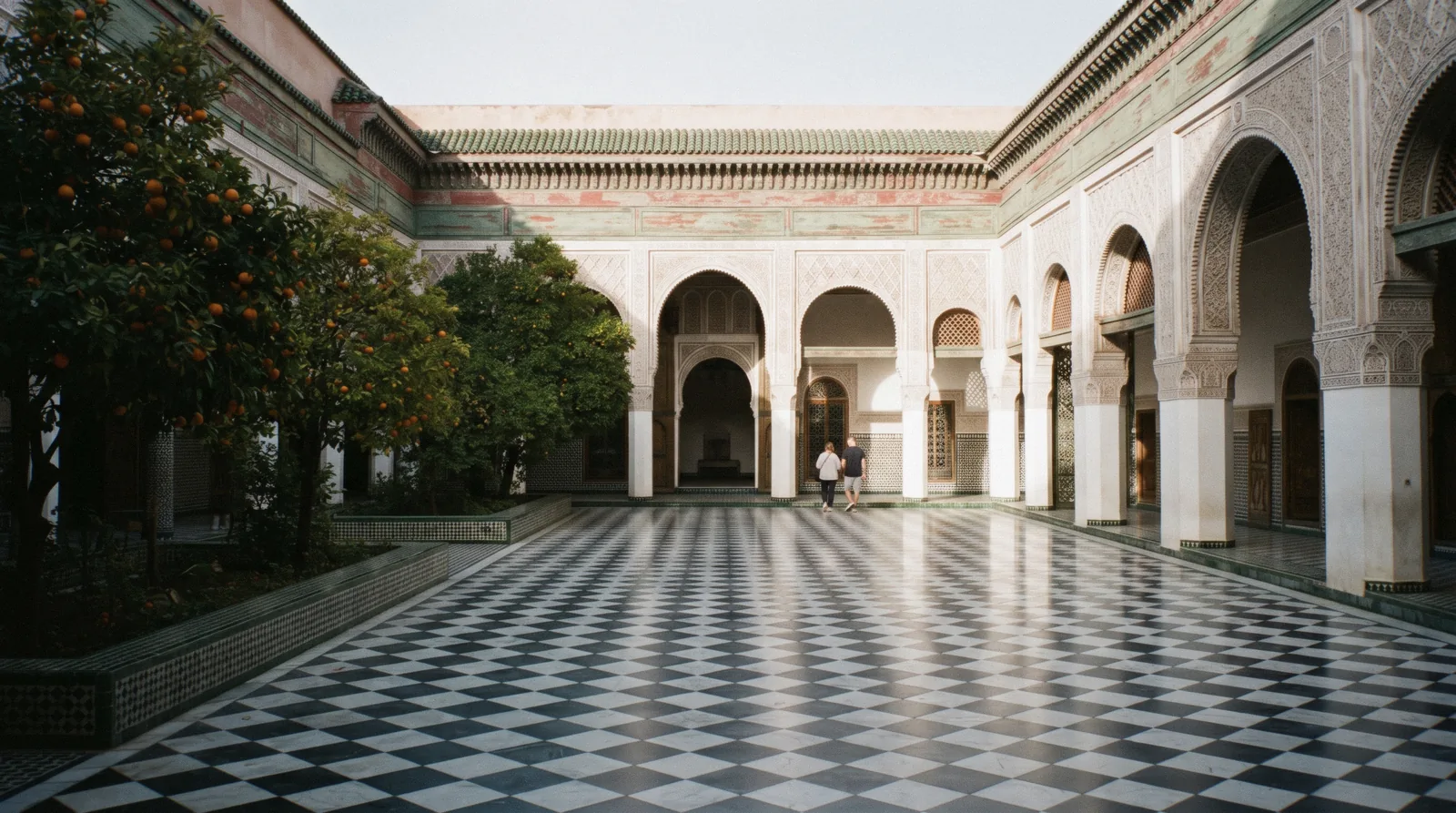
If you only do one, do the Bahia. It is the intact building: eight hectares of courtyards with painted cedar ceilings, zellij and stucco still in place, and it gives a first-time visitor far more to look at than a ruin does. El Badi is the better visit if you like archaeology, rooftops and space, or if you are travelling with children who need somewhere to run.
Key takeaways
- The tariff is identical at both gates, $10.65 (100 MAD) for a foreign adult against $3.20 (30 MAD) for a Moroccan or resident adult, and both are sold on the same state platform listed on the ticket index
- Both open 09:00 to 17:00 and neither publishes a closing day, so the only day that changes anything is Friday, when Moroccan nationals enter free and the courtyards fill: the Friday rule in full
- Allow about 45 minutes each at a walking pace, 90 at the Bahia if you intend to read the ceilings, and 75 at the ruin if you go down into the vaults and up onto the walls
- A ninety-minute guided visit of the Bahia with entry handled is listed below the gate fare, the one case in this city where a guide undercuts a door.
- Doing both is the normal plan, not an ambitious one: they stand about eight minutes apart on foot, and the one-day route threads them together with the Saadian Tombs
What Each Palace Actually Is
The Bahia: a vizier's house with its decoration intact
The Bahia was never royal. It was built by two men who ran Morocco on the sultan's behalf: Si Moussa, a chamberlain who rose to grand vizier, whose two garden chambers carry an inscription dating them to 1866 and 1867, and his son Ba Ahmed, who held the same office and expanded the house between 1894 and 1900. The Ministry of Culture describes the result in a single sentence, as eight hectares built in two phases in the second half of the nineteenth century with courtyards, gardens, salons and outbuildings in marble, moucharabieh, zellij, stained glass, carved and painted wood and stucco. That sentence is the entire official description. There is no plan, no room list and no route.
What that means on the ground is a visit made of ceilings. The rooms are empty of furniture, because Ba Ahmed died in 1900 and the palace was reportedly stripped within hours on the sultan's order, so the walk is about looking up: painted cedar in geometric panels, carved plaster over the doors, and the marble grand courtyard where every photograph in circulation is taken. That courtyard, incidentally, is the newest part of the house, dated 1896 to 1897. The architect of the expansion was Muhammad ibn Makki al-Misfiwi, 1857 to 1926, one of very few nineteenth-century Moroccan builders whose name survives attached to a building you can walk into. Because the official description is a single sentence with no route, marrakech guided tours are the easiest way to get a room-by-room reading of the Bahia's ceilings and courtyards.
El Badi: the negative of a building
El Badi is three hundred years older and almost nothing of it is left standing. Ahmad al-Mansur began it within months of the Saadian victory at the Battle of the Three Kings in 1578, and paid for it with ransom money and with sugar: Italian columns were bought by weight in sugar, while lime and plaster came up from Timbuktu. Fifteen years of building produced a courtyard 135 metres by 110 with a pool down the middle and four sunken orange orchards around it.
Then it was taken apart. Maintenance stopped when al-Mansur died in 1603, Moulay Rashid used it briefly in 1668 and 1669, and around 1707 Moulay Isma'il ordered the materials carried off to build his new capital at Meknes. Saadian fragments from this courtyard turn up in buildings as far away as Algiers. What you buy a ticket for now is the shape of the thing: rammed-earth walls with nothing on them, the orchards still sunken, an unmarked stair down into the vaulted hydraulic system that fed the pools, another stair up to a terrace on the ramparts, and storks nesting on the wall heads all year rather than seasonally. Inside, one room holds the twelfth-century minbar brought here from the Koutoubia mosque, alongside exhibition spaces that opened in 2018.
Source: Wikipedia, Bahia Palace, Wikipedia, El Badi Palace, Ministry of Culture.
The Ministry's Own Page Describes The Wrong Palace
Before you compare anything else, know that the official source confuses the two itself. This takes thirty seconds to check and it explains a great deal of the muddle in circulation.
The state ticket page for the Palais Badii describes the palace as founded in 1886 by Abi Imrane Moussa Ben Ahmed Ben Mbarek, grand vizier, and enlarged by his son Ba-Hmad. Those are the two men who built the Bahia, three centuries later and a kilometre north-east. The Ministry of Culture has printed one palace's history on the other palace's ticket page.
So copy nothing from the official text: a visitor expecting a nineteenth-century house with painted ceilings finds a Saadian ruin instead, and half the online complaints that El Badi is "just walls" come from that swapped expectation. The two palaces deserve to be kept apart.
Source: Ministry of Culture, Palais Badii, Palais El Bahia.
The Two Palaces, Line By Line
All prices and hours in this table come from the Ministry of Culture's ticket pages for the two monuments. Visit lengths are suggested routings only, as the Ministry recommends no durations.
| The Bahia | El Badi | |
|---|---|---|
| Built | 1866 to 1867, then 1894 to 1900 | Begun 1578, complete by the 1590s |
| Foreign adult | $10.65 (100 MAD) | $10.65 (100 MAD) |
| Moroccan or resident adult | $3.20 (30 MAD) | $3.20 (30 MAD) |
| Foreign child 7 to 13 | $5.33 (50 MAD) | $5.33 (50 MAD) |
| Hours | 09:00 to 17:00, no closing day stated | 09:00 to 17:00, no closing day stated |
| What survives | Ceilings, zellij, stucco, four courtyards, no furniture | Walls, sunken orchards, vaults, ramparts, the Koutoubia minbar |
| Shade | Continuous, most of the route is roofed or planted | Almost none until you reach the vaults |
| Our routing | 45 minutes walking, 90 reading the ceilings | 45 minutes walking, 75 with the vaults and the walls |
The two rows that decide most visits are the last three. The price is the same, the hours are the same, and the actual difference is that one visit is a roof over your head and a ceiling to look at, and the other is an open rectangle in full sun with a view at the end of it.
How Long Each One Really Takes
Neither monument states a visit length, so what follows is our own routing, written down so you can argue with it rather than guess at it.
The Bahia is the one that stretches. Four courtyards, the small riad garden, the council chamber and the apartments come to about 45 minutes if you keep moving, and about 90 if you stop under each ceiling and work out what is painted, carved and inlaid. There is no signage worth reading, which is exactly why the ceilings reward slowness: nobody is going to tell you that the grand courtyard is the newest room in the building unless you have read it beforehand or you are paying somebody to say it out loud.
El Badi is the one people underestimate in the wrong direction. Walked as a rectangle it takes twenty minutes and feels thin. Walked properly it takes 75: down the unmarked stairs into the vaults, which are the coolest place on the site at midday, into the room with the minbar, and up onto the rampart terrace for the view over the Kasbah quarter towards the Atlas. Miss those three and you have paid $10.65 (100 MAD) for a lap of a field.
The planning number, if you want one: 90 minutes for the two of them at a brisk pace including the eight-minute walk, or a comfortable two and a half hours if you are actually looking. That is the shape the one-day route through the medina is built around, and both fit inside a morning with the Saadian Tombs added.
Crowds, Friday And The Best Hour To Arrive
The two buildings handle a crowd very differently, and this is worth more than any price comparison. The Bahia funnels every group through the same sequence of doorways, so a coach party arriving at 10:30 turns the grand courtyard into a queue for a photograph and the corridors into single file. El Badi is a field with walls around it: the same number of people disappear into it. If your only free slot is late morning in high season, that asymmetry alone should decide your order.
Friday is the one calendar fact that changes both. Moroccan nationals enter every state monument free on Fridays and on the first day of national and religious holidays, which visitors do not, so Friday is the fullest day at both gates. That is our reading of the published tariff rule rather than an official visitor count, and it is set out with the rest of the closures on the Friday and holiday page.
Arrive at nine, or after three
Both gates open at 09:00 and both stop selling at some point before 17:00 that neither publishes. The first hour is the quiet one at the Bahia and the last hour is the good one at El Badi, because the low sun on the rammed earth is the whole point of the ruin photographically and the storks are on the wall heads rather than out feeding. A sensible pairing on a hot day is the Bahia at opening, lunch, then El Badi late; on a cool day, reverse it and take the ramparts in the morning light.
One closure worth knowing about
The ruin has been shut once in recent memory and it was not for a holiday. The September 2023 earthquake cracked walls in its exhibition rooms and around the modern toilets, and the site closed for repair and reopened to visitors the following month. Neither monument publishes a closing day, a last-entry time or an accessibility statement, and the Ministry's page for each runs to a tariff, the 9h to 17h hours and the free-entry line.
If you need certainty about either on a specific morning, the only reliable move is to arrive at 09:00 and look, which costs you nothing because there is no slot to lose.
Source: Ministry of Culture.
Which One, By The Kind Of Trip You Are Having
If you have one morning and have never been to Morocco
the Bahia. It is the intact building, and a first visit to a Moroccan palace should have a ceiling on it.
If you like ruins, plans and archaeology
El Badi, with the vaults and the rampart terrace done properly rather than skipped.
If you are travelling with children
El Badi. It is open ground with storks on the walls and stairs to climb, and a foreign child of 7 to 13 pays $5.33 (50 MAD); see also Marrakech with kids.
If it is July or August and you are out at midday
the Bahia. The route is shaded almost throughout, where the ruin is a sun trap with no cover until you find the stairs down.
If you want a guide and are watching the budget
the Bahia, because a ninety-minute guided visit with entry included is listed under the price of the gate ticket.
If you have half a day and want both
start at the Bahia at 09:00, walk eight minutes south, and finish in the ruin; add the Saadian Tombs and three admissions come to $32.00 (300 MAD).
Guided Ways Into One Or Both Palaces
Every card links to the operator's own page, where the calendar shows what is open on your date. Prices are GetYourGuide's listed figures, and ratings and review counts are the operator's own. Unless the card says otherwise, the 100 MAD admission at each gate is paid in cash on site.
 from $8
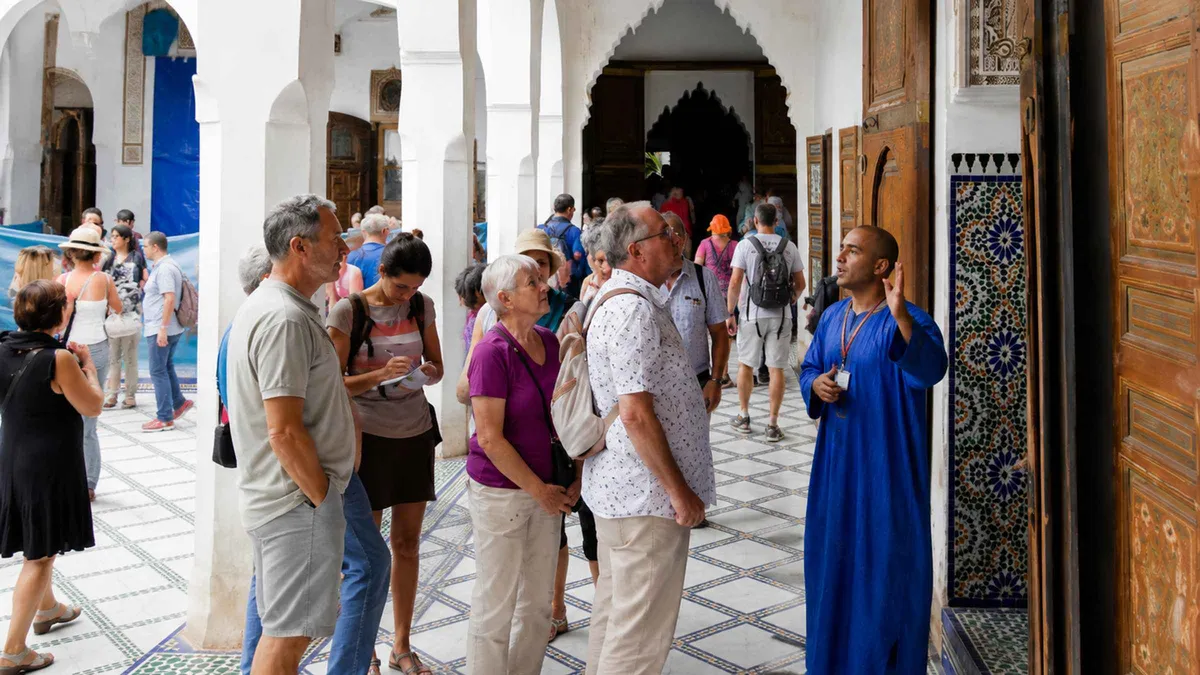
Marrakech: Bahia Palace Guided Tour with Skip-the-Line Entry
listed at $8
Ninety-minute guided visit of Bahia Palace with the guide handling the entry line, then free time inside. Some sections of the palace are under renovation.
Check Availability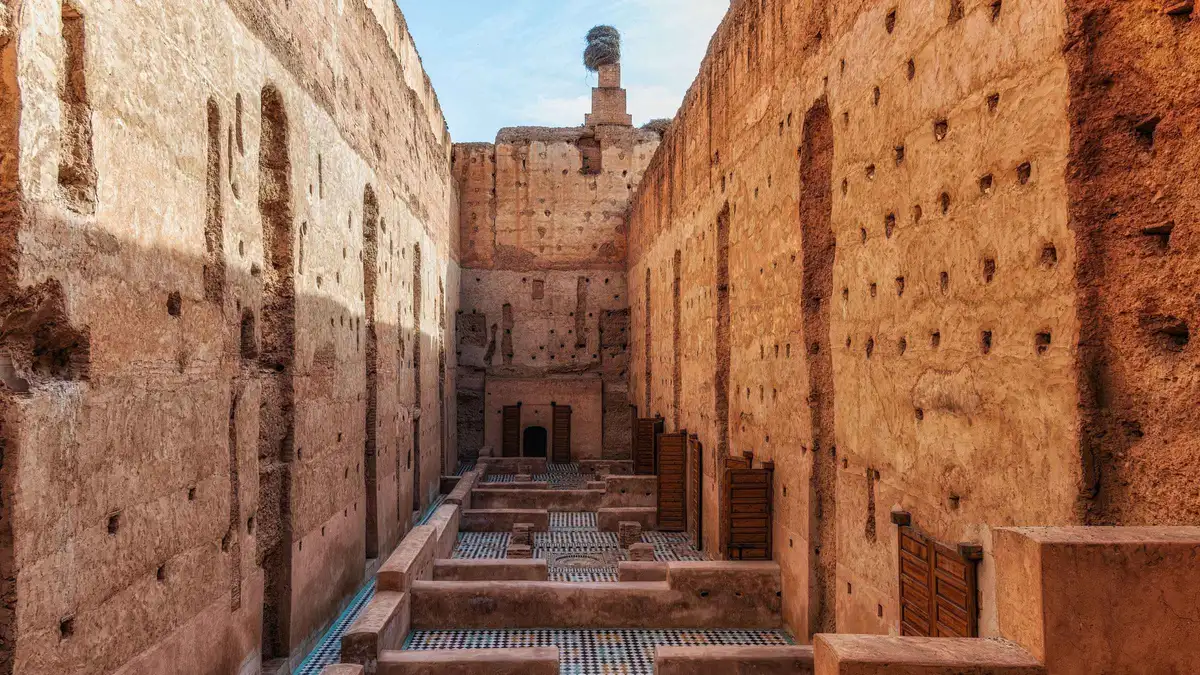 from $17.44
Marrakech: El Badi Palace Entry Ticket & Souvenir Postcard
listed at $17.44
Entry ticket to El Badi Palace with a souvenir postcard; the voucher is the ticket and there is no fixed entry time. The palace opens 09:00-17:00 with last entry at 16:30.
Check Availability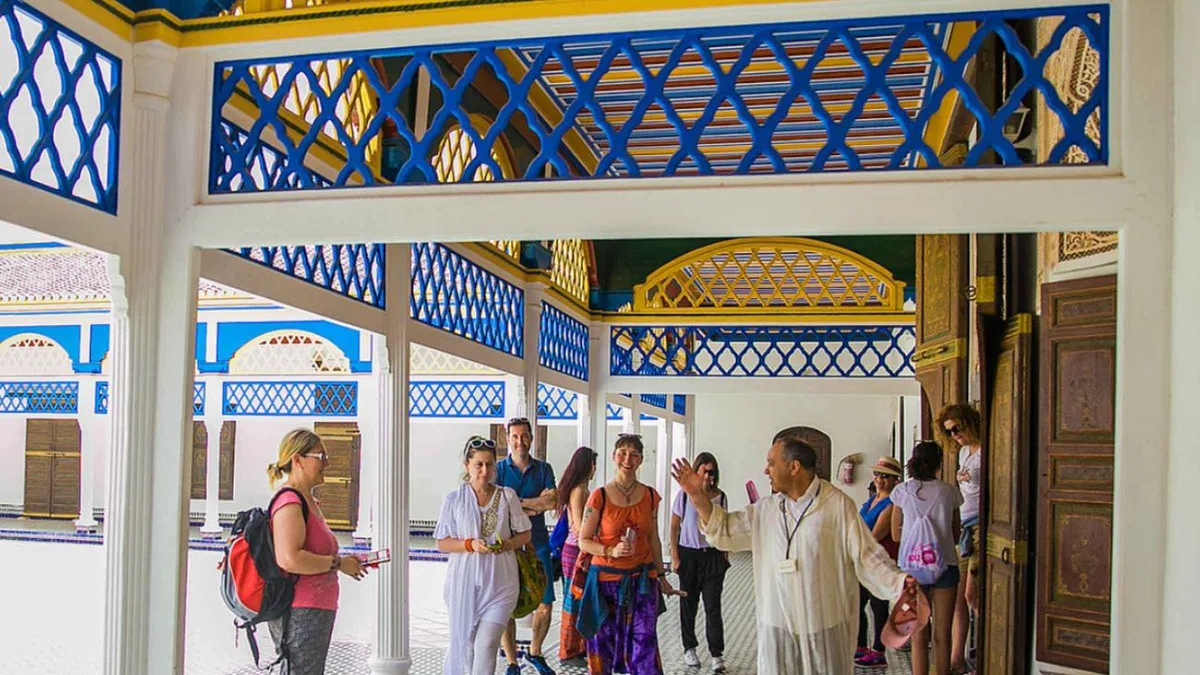 from $17.58
Marrakech: Bahia Palace, Saadian Tombs, Souk and Medina Tour
listed at $17.58
Four-hour licensed-guide walk covering Bahia Palace, the Saadian Tombs, the souks and the medina, with a WhatsApp reminder the day before. Monument tickets are paid in cash on site: 100 MAD per adult per monument, 30 MAD ages 7-13.
Check Availability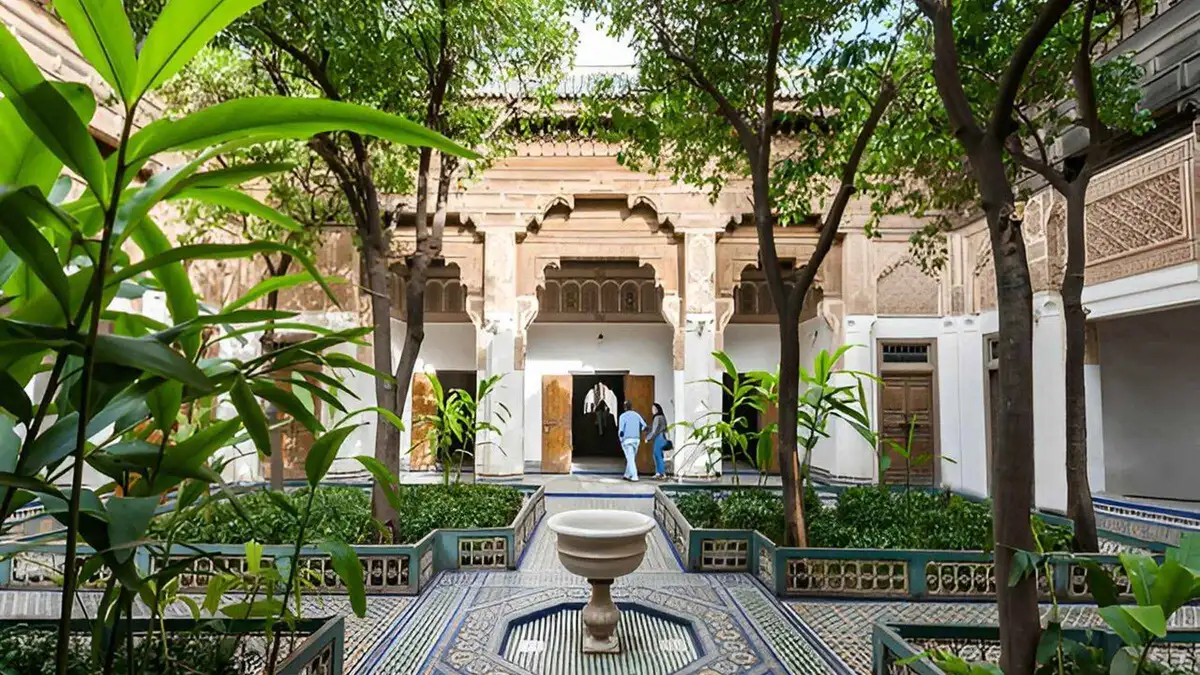 from $17.44
Marrakech: Bahia Palace, Saadian Tombs, & Koutoubia Mosque
listed at $17.44
Three-hour guided walk taking in Bahia Palace, the Saadian Tombs and the Koutoubia from the outside. Monument entrance fees are paid separately in cash: 100 MAD each for Bahia Palace and the Saadian Tombs.
Check Availability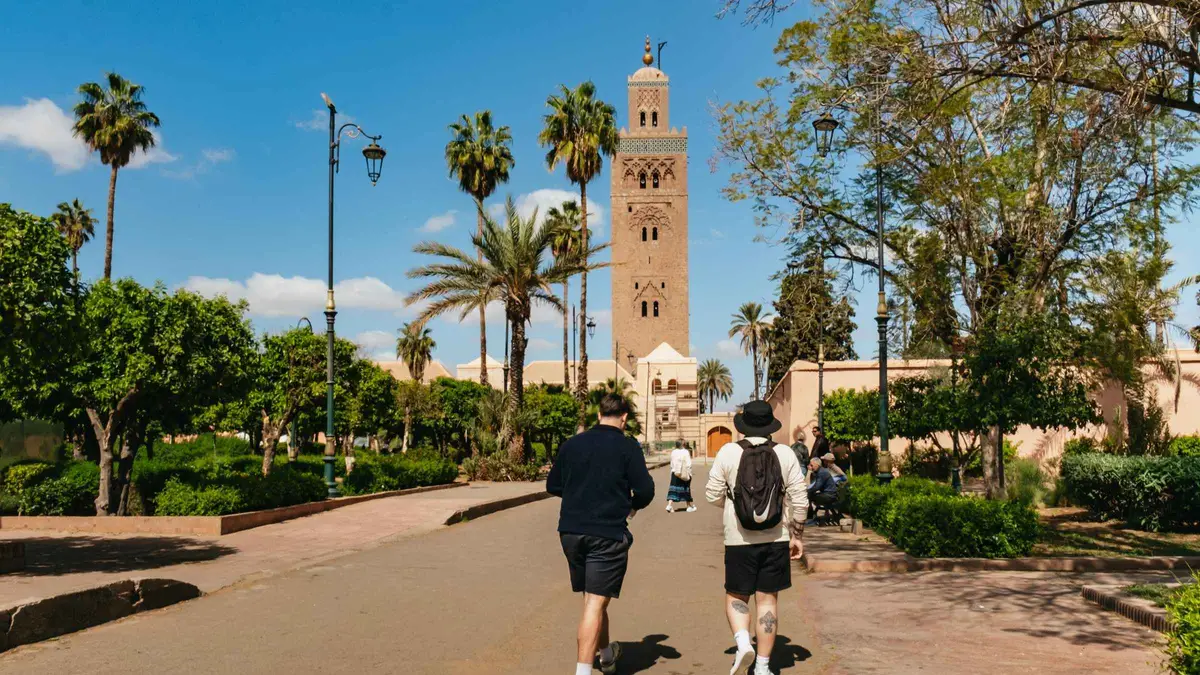 from $16.85
Marrakech: Saadian Tombs & Bahia Palace, Medina Guided Tour
listed at $16.85
Four-hour guided walk linking the Saadian Tombs, Bahia Palace and the medina lanes, with pickup available. Runs in several languages and is sold as shared or private.
Check Availability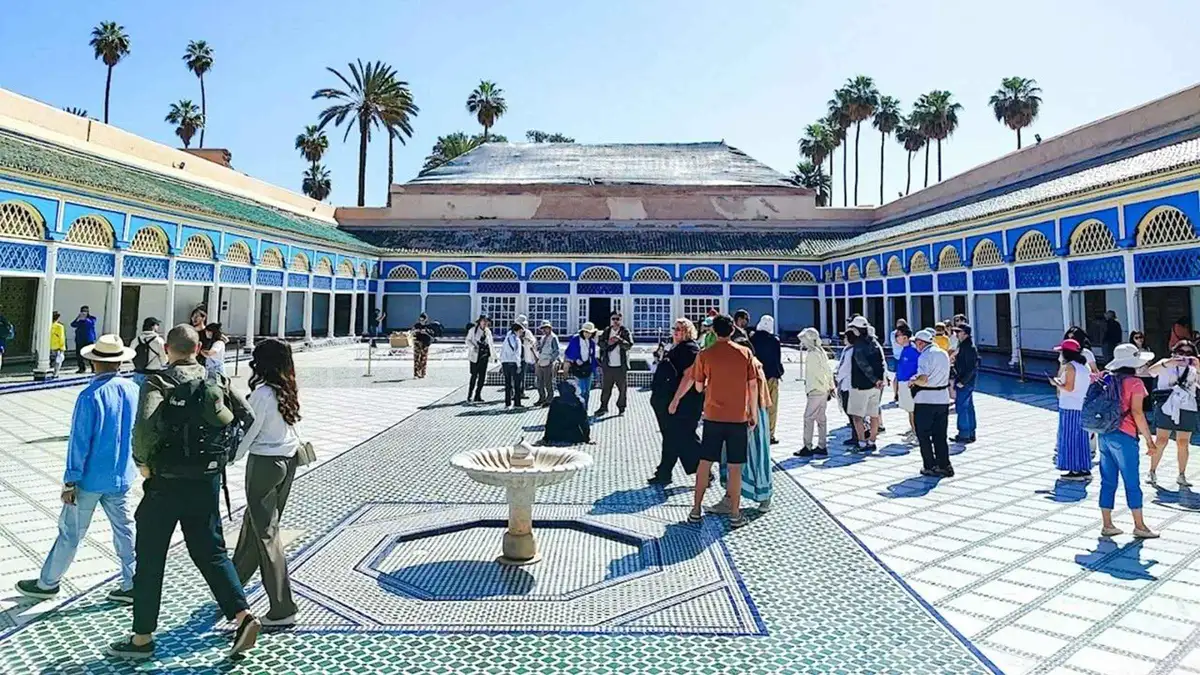 from $20.92
Marrakech: Bahia Palace, Saadian Tombs & Medina Walking Tour
listed at $20.92
Three-hour private walking tour of Bahia Palace, the Saadian Tombs and the medina with a local guide and water. Monument tickets are not included and are paid in cash at each gate.
Check AvailabilityPrices, ratings and details are the platform's own. Dollar figures are the listed prices. The platform bills in your account's currency.
Doing Both, And The Walk Between Them
The two gates are about eight minutes apart on foot, south-west from the Bahia's entrance on Riad Zitoun el-Jdid, past Place des Ferblantiers and the metalworkers' stalls, and in through the wall to Ksibat Nhass. The walk crosses the edge of the Mellah, which is a reason to do it slowly rather than by taxi, and it puts you within a few minutes of the Saadian Tombs on the far side of the Kasbah quarter.
Order matters more than distance. Take the Bahia first at opening, when its courtyards are still empty, and leave the ruin for the flat afternoon light. If you are adding a third monument, add the Saadian Tombs rather than a museum: all three are on the same state tariff, all three sell at the gate, and three foreign adult admissions come to $32.00 (300 MAD) before lunch.
What not to do is buy a combined guided walk expecting the admissions to be inside the price. On most of the cards above the guide is included and the monument fees are not, so the real cost of a three-monument morning is the card price plus 300 MAD in cash. Cards that do include entry say so explicitly, and the ticket index sets the official price beside each one.
The Questions People Actually Ask About These Two
Is one of the two cheaper to get into?
No. They sit on the same Ministry of Culture tariff: $10.65 (100 MAD) for a foreign adult, $5.33 (50 MAD) for a foreign child of 7 to 13, $3.20 (30 MAD) for a Moroccan or resident adult and $1.07 (10 MAD) for a Moroccan or resident child. There is no combined ticket for the pair and no city pass that covers them, which the ticket index sets out in full.
If I only have ninety minutes, which one should I choose?
The furnished one. Ninety minutes is exactly the time the Bahia rewards, and a ruin at speed is a rectangle. If your ninety minutes fall between 10:30 and midday in high season, reverse that advice: the crowd inside the intact building at that hour will cost you more than the ruin's emptiness will.
Are they close enough to see in one morning?
Yes. About eight minutes separates the two gates on foot, and the pair takes 90 minutes brisk or two and a half hours properly. Adding the Saadian Tombs makes a natural three-stop morning that the one-day route builds the rest of the day around; a four-hour guided walk covers the same ground with a licensed guide.
Why do the rooms have no furniture in them?
Different reasons in each case. The nineteenth-century house was reportedly stripped on the sultan's orders within hours of its owner's death in 1900 and was never refurnished, so the decoration is the entire visit. The sixteenth-century one was dismantled for building material around 1707 and carried off to Meknes, so what remains is the footprint. Neither was emptied by a museum.
Which is better for photographs?
They photograph at different hours. The marble courtyard of the intact palace wants the first hour after opening, before the groups; the ruin wants the last hour, when the low sun works on the rammed earth and the storks are back on the wall heads. Both are covered in more detail on the two monument pages, here and here.
Do I need to book either of them in advance?
No. Neither sells timed entry and neither holds separate online stock: the state platform and the gate sell the same ticket at the same price, so the queue is a till queue rather than a slot. Almost nothing in this city needs booking weeks out, which is the argument set out in our booking calendar.
Inside Both, Before You Choose
Three walk-throughs that show what the two visits actually look like: the ceilings in the intact house, the scale of the ruin, and how the Saadian palace came apart.
Bahia palace | Marrakech, Morocco |4k|
The whole route through the intact palace in order, which is the visit most first-timers are choosing between.
Video: Morocc_OH!El Badi Palace l Marrakech, Morocco |4k|
The ruin at walking pace, including the sunken orchards and the stairs most visitors never find.
Video: Morocc_OH!The Rise and Fall of Badi Palace, Marrakesh Morocco
Why the Saadian palace is empty: the building, the dismantling and where its marble went.
Video: AleAlejandroVideos load from YouTube only when you press play.