 Marrakech Guidebook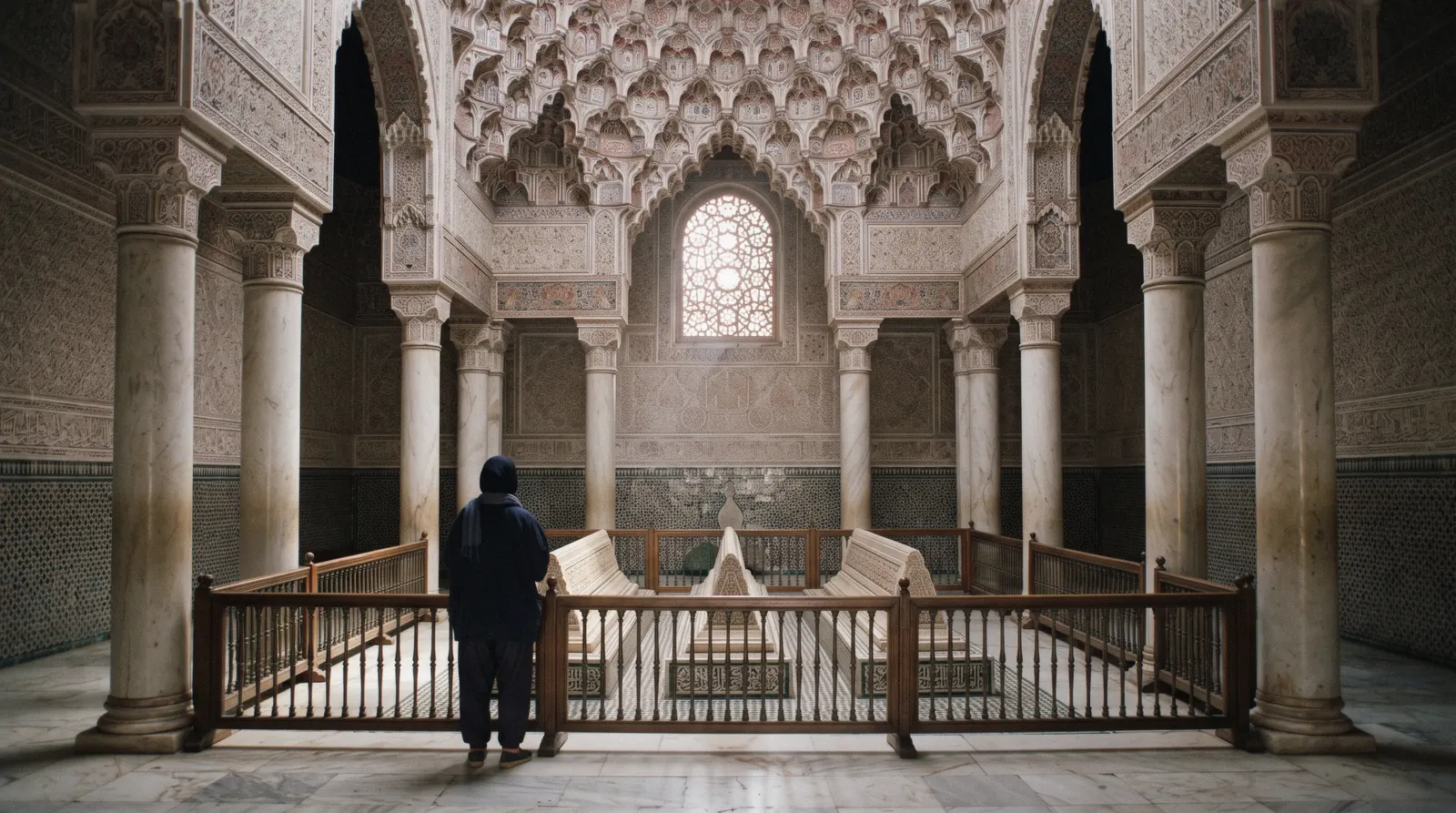
Saadian Tombs
The Saadian Tombs are the royal necropolis of the Saadian dynasty, walled into the kasbah quarter behind the Kasbah Mosque and holding the grave of Ahmad al-Mansur under twelve columns of Carrara marble. This page covers the hours, the official tariff, the one queue that forms inside, how long the visit really takes and what stands within ten minutes of the gate; the wider ticket picture is on the Marrakech tickets index and the quarter itself on the Kasbah page. For how this page fits the rest of a trip, see what to see in Marrakech.
Quick answer Hours, price, the one queue, how long to allow
The Saadian Tombs open daily 09:00 to 17:00 and a foreign adult pays $10.65 (100 MAD), at the window or in advance on the Ministry of Culture's own platform. There are no timed slots and no weekly closing day is published.
Key takeaways
- The site is two mausoleums and a garden of tiled graves inside one walled enclosure, and most visitors are through it in 45 minutes; the standalone entry ticket sold online is listed above the 100 MAD window price, so it buys a voucher rather than a saving
- One queue forms, at the Chamber of the Twelve Columns, where Ahmad al-Mansur lies under twelve Carrara marble columns and visitors look in from a single doorway; the first hour and the last two hours are the thin ones
- El Badi Palace stands six minutes away on the same 100 MAD tariff, and a four-hour guided walk links these tombs, Bahia Palace and the souks for about the price of two gate tickets
Key facts
Opening hours
| Daily, as published on the Ministry ticketing platform | 09:00–17:00 |
|---|
Closed None published. The Ministry's page states no weekly closing day and no annual closure
Admission
- Adult
- $10.65 (100 MAD) foreign adult
- Reduced
- $3.20 (30 MAD) Moroccan nationals and residents; $5.33 (50 MAD) foreign child 7 to 13; $1.07 (10 MAD) Moroccan child 7 to 13
- Free
- Persons with reduced mobility; Moroccan nationals every Friday and on the first day of national and religious holidays
Planning it
- Time needed
- Not stated by the Ministry; our routing: 45 minutes, an hour when the Twelve Columns queue has formed
- Book ahead
- Optional — walk-up usually fine
- Address
- Rue de la Kasbah, beside the Kasbah Mosque, Medina, Marrakech. The Ministry gives the location as north of the Almohad Kasbah
Three ways in, priced from the Ministry of Culture's own ticketing platform at e-services.minculture.gov.ma and from GetYourGuide in Q3 2026. The Ministry sells the same ticket at the gate and online for 100 MAD, so the platform rows are buying convenience or a guide rather than a cheaper entry. Nothing here is timed, and no seller offers a queue-skip because the queue that exists is inside the building, not at the door.
Are you paying for the entry itself, or for a guide who explains what the twelve columns are doing there?
| Option | Price | Includes | Cancel | Book |
|---|---|---|---|---|
| Ministry of Culture ticket, gate or onlineThe default, and the cheapest. Minimum one ticket per order; a Pass Jeunes option is offered on the platform | $10.65 (100 MAD) adult; $5.33 (50 MAD) child 7 to 13 | Entry to the enclosure and both mausoleums | Not stated | Official site |
| Entry ticket with souvenir postcard, GetYourGuideAnyone who wants a voucher in hand and no cash at the window; it carries no reviews yet, and it costs more than the 100 MAD gate price | Listed at $17.44 | Entry, plus a postcard posted to your address | Non-refundable once booked | Check Availability |
| Guided walk, tombs plus Bahia Palace and the medina, 4 hVisitors who want the dynasty explained and a route through the lanes; add $10.65 (100 MAD) per monument in cash | From $16.85 | Licensed guide, souks and medina route; monument entries paid at each gate | Free up to 24 hours before | Check Availability |
The arithmetic that matters: the guided walk is listed under the price of the standalone entry voucher, but the walk does not include the 100 MAD entries and the voucher does. Two adults doing the tombs alone pay $21.30 (200 MAD) at the window; the same two on the guided walk pay about $33.70 for the guiding and $42.60 (400 MAD) in gate fees for the two monuments it covers. Listed platform prices move with the date, so treat the card figure as final only once the checkout shows it.
Ways into the Saadian Tombs, compared
Two cards cover this monument. The first is the only standalone entry product for the tombs on any platform, which is why it is here despite carrying no reviews; the second is the guided walk most visitors actually book, because it also takes in Bahia Palace and the souks. Prices are as listed.
 from $17.44
Marrakech: Saadian Tombs Entry Ticket with Souvenir Postcard
listed at $17.44
Standalone entry ticket to the Saadian Tombs with a souvenir postcard; the voucher works as the ticket. The tombs open daily 09:00-17:00, last entry around 16:30.
Check Availability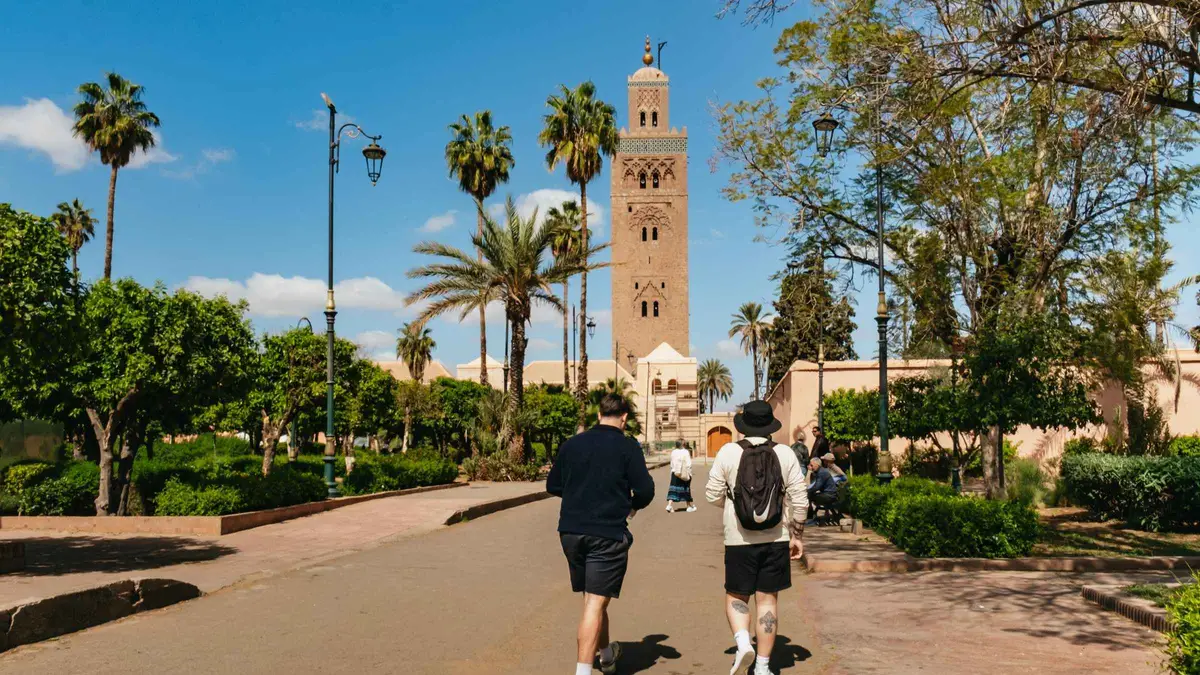 from $16.85
Marrakech: Saadian Tombs & Bahia Palace, Medina Guided Tour
listed at $16.85
Four-hour guided walk linking the Saadian Tombs, Bahia Palace and the medina lanes, with pickup available. Runs in several languages and is sold as shared or private.
Check AvailabilityPrices, ratings and details are the platform's own. Dollar figures are the listed prices. The platform bills in your account's currency.
What the Saadian Tombs Are, And Why They Were Lost
A short history, because almost nothing on the site is labelled and the guides outside the gate charge for the story.
This is a garden cemetery inside the walled kasbah quarter, tucked behind the qibla wall of the Kasbah Mosque, which the Almohad ruler Abu Yusuf Ya'qub al-Mansur built along with the royal citadel in the late twelfth century. Burials were happening on the ground long before the Saadians arrived: the Marinid sultan Abu al-Hasan was buried here in 1351 after dying in exile in the High Atlas, and his marble tombstone still sits in the Chamber of the Three Niches even though his body was moved to Chellah near Rabat a few months later (Wikipedia's account, drawing on Deverdun and Salmon).
The buildings you pay to see are Saadian. The eastern mausoleum began as a single square chamber that Moulay Abdallah al-Ghalib raised between 1557 and 1574 over the grave of his father Muhammad al-Shaykh, the first Saadian sultan to rule a unified Morocco. The western mausoleum, the one with the marble columns, was built for Ahmad al-Mansur himself between 1591 and 1598 and holds his grave from 1603.
Five sultans and royal wives lie under the largest tombstones, all carved in Carrara marble in a style so consistent that scholars read them as the work of one workshop between 1603 and 1655.
The sealing, and the 1917 rediscovery
The Alawi sultan Moulay Isma'il, who reigned from 1672 to 1727 and demolished the Saadian palaces at El Badi for materials, did not destroy the necropolis. He sealed it off from most of the surrounding buildings instead. Burials continued in a quieter way, the Chamber of the Mihrab filling with Alawi graves, and then the enclosure was cut off from the streets altogether and dropped out of use.
In 1917 the Service des Beaux-Arts, Antiquites et Monuments historiques, created in 1912 at the start of the French Protectorate, opened the site up, restored the decoration using surviving fragments as the model, and admitted the public for the first time. Everything you walk through is therefore a hundred years of public access on top of three centuries of being walled in, and it explains why the tombs feel like a discovered room rather than a monument.
The September 2023 earthquake damaged the enclosure. The first surveys found significant cracks in the surrounding walls and towers, partial collapses near the entrance, roof damage on the eastern mausoleum and harm to the stucco of the western one; the tombstones themselves came through. The site closed for repairs and reopened to visitors the following month.
Anything you read about the tombs being shut is out of date.
What To See: Two Buildings, Seven Rooms And A Hundred Graves
The enclosure is small enough to see everything, so the question is not what to skip but what to stand in front of and for how long.
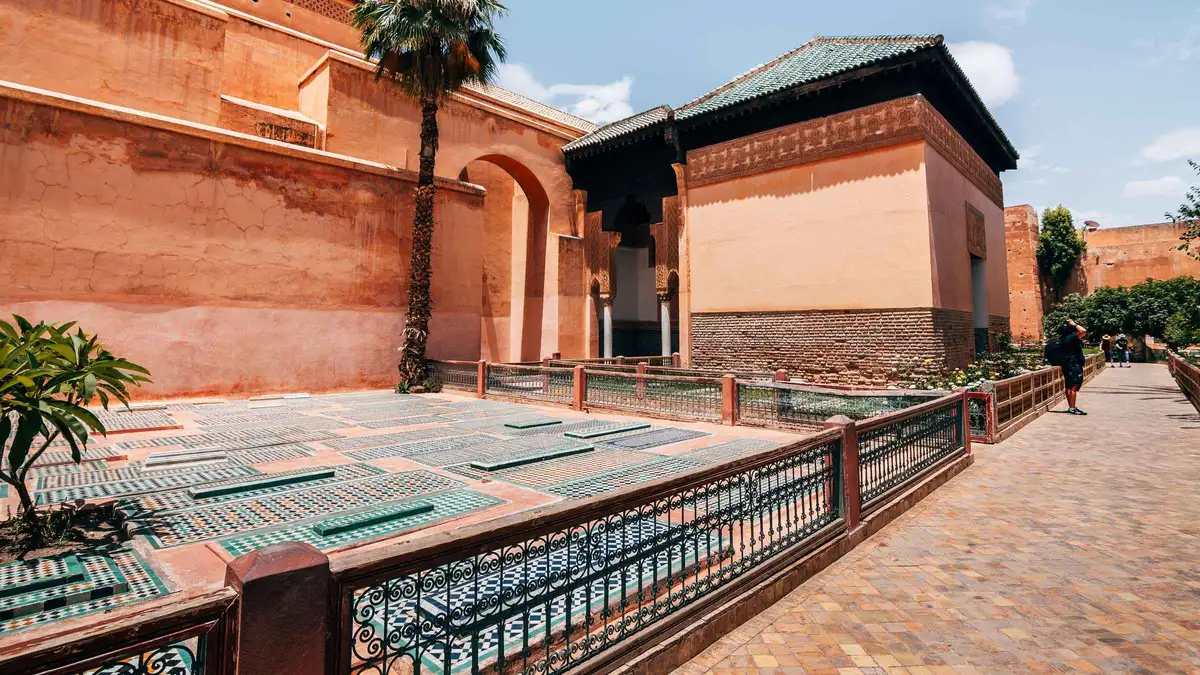
Walk in and the garden is in front of you: paths between graves covered in coloured tile, roughly a hundred of them, plus 56 marked with mqabriyas, the elongated carved marble epitaphs reserved for people who mattered. The two mausoleums face each other across it. Most visitors turn left to the western building first because that is where the queue is; the calmer sequence is to take the eastern mausoleum first, then the garden, then join the western queue when it has thinned.
The western mausoleum, the one people come for
Three rooms. The Chamber of the Mihrab was built as a prayer room and is now carpeted with Alawi graves, reputedly including the sultan Moulay al-Yazid who died in 1792, so visitors are kept out of it and look in. The Chamber of the Twelve Columns is the room in every photograph: ten metres square, twelve metres high, twelve Carrara marble columns in groups of three, marble muqarnas arches cut so finely that the join between marble and stucco is hard to find, and cedar ceilings painted red and gold.
Ahmad al-Mansur's tombstone lies in the centre, his son Moulay Zidan to the right, Muhammad al-Shaykh al-Saghir to the left. The Chamber of the Three Niches next door has the most intricate stucco of the whole complex and, being an annex, is where you get a minute alone.
The eastern mausoleum, which almost nobody queues for
The Qubba of Lalla Mas'uda is the older building and it rewards the two minutes most people do not give it. The central chamber is four metres square under a muqarnas vault that still carries its blue and gold paint, with a mihrab-shaped niche over the grave of Lalla Mas'uda, mother of Ahmad al-Mansur, who died in 1591. The dedicatory marble panel below it is the best preserved carving on the site, because it spent centuries behind wooden shutters.
The Grand Chamber to the south, ten metres by six, is plainer above and carries sixteen-point star zellij below, under a berchla wood-frame ceiling that still shows its colours.
Two details worth hunting. The loggias on either side of the eastern mausoleum, each four metres by two, carry a cedar canopy on marble columns with a carved band of Qur'anic calligraphy from Surah al-Ahzab. And in the Chamber of the Twelve Columns, the marble inscription plaque set into the back wall is dedicated to Muhammad al-Shaykh, who is buried in the other building across the garden; nobody knows when it was moved or why.
How Much Time To Give The Saadian Tombs
No visit length is published, so the three routings below are timed door to door from the gate on Rue de la Kasbah and include the wait at the Twelve Columns doorway. They assume you already hold a ticket or buy one at the window in under five minutes.
The honest answer is that this is a 45-minute monument that people plan an afternoon around. It is one walled garden with two buildings in it, and the room everyone photographs is viewed from a doorway rather than walked through. That is not a criticism, it is the reason the visit slots so easily beside El Badi and Bahia; it is also why arriving at 14:00 in July, when the queue at the doorway is at its longest and the garden has no shade, turns a short pleasure into a long one.
| Routing | Door to door | What you get | What you skip |
|---|---|---|---|
| Short, at opening | 30 to 40 minutes | Both mausoleums, the Twelve Columns with almost no wait, the garden on the way out | The eastern loggia details and the epigraphy; no time to sit |
| Full, unhurried | 1 hour to 1 hour 15 | Every room, the Three Niches twice, the Lalla Mas'uda niche and the calligraphy bands, plus the garden graves | Nothing on this site; you will be waiting 10 to 20 minutes at the doorway if you come at midday |
| With a guide, as part of a walk | 3 to 4 hours total | The dynasty explained here, then Bahia Palace and the souks on the same four-hour walk | Free time inside; the group moves as one and the tombs are one stop of several |
Pair it with El Badi rather than with a garden. The two sites are a six-minute walk apart, both on the same 100 MAD tariff, and they explain each other: al-Mansur built the palace and lies in the necropolis, and Moulay Isma'il stripped the first and sealed the second. Two adults doing both pay $42.60 (400 MAD) and need about two and a half hours including the walk.
Hours, The Friday Effect And The Quiet Slots
The Ministry of Culture publishes one line of hours and no closing day. Everything else below is either the tariff rule that changes who is standing beside you, or our own reading of when to come.
The platform gives 9h to 17h, daily, with no weekly closure and no seasonal variation. There is no published last-entry time; assume the ticket window stops selling well before 17:00 and do not arrive after 16:15 expecting an unhurried hour. No Marrakech monument on the Ministry's platform uses timed entry, so a ticket bought online is the same ticket as the one at the window and carries no slot.
Why Friday afternoon is the busiest hour of the week
The Ministry tariff is two-tier and the second tier has a free day. A Moroccan national or resident pays 30 MAD where a visitor pays 100, a Moroccan child of 7 to 13 pays 10 where a foreign child pays 50, and Moroccan nationals enter free every Friday and on the first day of national and religious holidays. Visitors do not.
The practical effect is that the enclosure fills with Moroccan families on Friday afternoons while a foreign visitor pays the full $10.65 (100 MAD) for the busier version of the same site. Nothing about that is unfair, but it belongs in your planning: the Friday and holiday openings page sets out which sites the rule covers.
Our reading of the quiet slots, and it is a reading rather than an official figure: be at the gate for 09:00 and you will have the Twelve Columns doorway to yourself for a few minutes, because the guided walks that start at 09:00 in Jemaa el-Fna do not reach the kasbah until about 10:00. The second window is after 15:30, when the coach groups have gone back for lunch and dinner. The worst hour is 12:00 to 14:00 in high season, when the doorway queue is single file and the garden has no shade at all.
During Ramadan the Ministry publishes no changed hours for its Marrakech monuments, though two privately run sites in the city do shorten theirs. Treat 9h to 17h as the figure for the Saadian Tombs until the platform says otherwise, and check the tickets index before a Ramadan visit.
Inside: The One Queue, Photographs And What Is Not Provided
The site provides very little beyond the buildings, which is worth knowing before you pay.
The queue is the visit's single frustration and it is structural, not a crowd problem. The original way into the Chamber of the Twelve Columns was through the prayer room, which is now full of Alawi graves and closed to visitors, so everyone enters through an opening in the eastern wall that started life as a window. That is why you look in rather than walk around, why the viewing is single file, and why the room takes minutes to see and can take twenty to reach in July.
Groups queue as one body, so a coach arriving ahead of you costs more time than twenty independent visitors.
There is no audio guide, no printed plan, no cafe, no cloakroom and, in the Ministry's own material, no stated accessibility provision beyond the line that persons with reduced mobility enter free. Guides wait outside the gate and are not part of the ticket; a licensed guide is regulated under Moroccan law and should be able to show a card, and the safety and scams page covers what to do about an unlicensed one. If you want the story told inside the enclosure, the sensible route is a booked guided walk rather than a negotiation at the door.
Photographs
The two rooms people photograph are lit from a doorway and a lantern, so mid-morning gives you the marble columns without the deep shadow of noon. The muqarnas vault in the Lalla Mas'uda chamber keeps a good part of its blue and gold and is the one shot in the complex that almost nobody takes, because the eastern building is behind them by the time they think of it. Tripods block a single-file doorway; leave one at the riad.
Getting There, And Which Gate
The tombs are in the kasbah quarter in the southern medina, which is the one part of the walled city a first-time visitor rarely reaches by accident.
From Jemaa el-Fna it is about 15 minutes on foot south along Rue Riad Zitoun el Kedim and then west, or a short petit taxi ride to Place Moulay al-Yazid. The landmark is the Kasbah Mosque with its green-tiled minaret: the ticket window and the entrance passage sit on Rue de la Kasbah on the mosque's southern side, reached through a narrow lane rather than off the square itself. The Ministry's own page places the monument north of the Almohad Kasbah; on the ground it is behind the mosque, and following the mosque is what works.
Bab Agnaou, the carved Almohad gate that opens the kasbah quarter from the outside, is the other useful landmark and a two-minute walk away. If you are coming by taxi, name Bab Agnaou or the Kasbah Mosque rather than the tombs; ask for the meter, which is compulsory under a 1963 dahir restated by Interior Ministry circulars, and see getting around Marrakech for what to do when it stays switched off.
The lanes on the approach are flat but narrow, and shared with handcarts and motorbikes. The enclosure itself is at ground level with shallow thresholds between the garden and the chambers, but no venue in this quarter publishes an accessibility statement and the Ministry's tariff mentions reduced mobility only in the free-entry line. That gap is real and it is not confined to this monument.
Saadian Tombs map: the gate and what is within ten minutes
The ticket window on Rue de la Kasbah, the mosque you navigate by, and the three ticketed sites within a ten-minute walk. Walk times are our estimates from the mapped distances.
Next stop from the Saadian Tombs
Walk minutes are our estimates from the mapped distances. All three are inside the southern medina, so none of them needs a taxi.
El Badi Palace
The palace Ahmad al-Mansur built and Moulay Isma'il stripped, now a vast sunken courtyard with storks nesting on the walls. $10.65 (100 MAD) on the same Ministry tariff and the same 9h to 17h hours, so El Badi Palace is the natural second half of the morning.
6 min walkThe Kasbah quarter
The Almohad royal quarter the tombs sit inside, entered through the carved gate of Bab Agnaou. Nothing to pay: the Kasbah is a lived-in district of lanes, the Kasbah Mosque and the square in front of it.
2 min walkBahia Palace
Eight hectares of courtyards under painted cedar, built in the 1860s and 1890s, and the third site on the 100 MAD tariff. Bahia Palace takes longer than the tombs and El Badi combined, so give it its own slot rather than tacking it on at 16:00.
12 min walkSaadian Tombs questions
How much is entry to the Saadian Tombs?
A foreign adult pays $10.65 (100 MAD) and a foreign child of 7 to 13 pays $5.33 (50 MAD), on the Ministry of Culture's own ticketing platform or at the window for the same money. Moroccan nationals and residents pay $3.20 (30 MAD), and their children of 7 to 13 pay $1.07 (10 MAD). The online entry ticket with a souvenir postcard is listed higher than the gate price, so it buys a voucher rather than a discount.
What are the Saadian Tombs opening hours?
Daily, 9h to 17h, as published on the Ministry platform, with no weekly closing day and no seasonal change. No last-entry time is published, so treat 16:15 as the point after which the visit is rushed. The site does not use timed slots, which is why nobody sells a skip-the-line ticket for it; the full picture for every monument in the city is on the tickets index.
How long do you need at the Saadian Tombs?
Forty-five minutes covers both mausoleums and the garden at a normal pace, and an hour is comfortable if the doorway queue at the Chamber of the Twelve Columns has formed. Thirty minutes is enough at 09:00 when there is no wait. The routing table above sets out all three.
Why do you queue to see Ahmad al-Mansur's tomb?
Because the original entrance to the Chamber of the Twelve Columns was through the prayer room, which is now filled with Alawi graves and closed off. Visitors enter instead through an opening in the eastern wall that was built as a window, so the room is viewed single file from a doorway rather than walked around. Come at opening or after 15:30 and the wait is a minute or two.
Are the Saadian Tombs still damaged from the 2023 earthquake?
No. The earthquake cracked the enclosure walls and towers, brought down parts of the structures near the entrance and damaged stucco in the western mausoleum, and the site closed for repairs. It reopened to visitors the following month and has been open since. Guides and blog posts saying it is shut predate the reopening.
Do the Saadian Tombs get free entry on Fridays?
Only for Moroccan nationals, who enter free every Friday and on the first day of national and religious holidays. A visitor pays the full $10.65 (100 MAD) that day, on a site busier than usual. If a free day matters to your budget, plan the medina and the Kasbah quarter around it instead, since neither charges anything.
Is a guide worth it at the Saadian Tombs?
Nothing inside is labelled, so a first visit without a guide or a read of the history section above is mostly beautiful rooms with no names attached. The efficient version is the four-hour guided walk that covers the tombs, Bahia Palace and the souks for about the price of two gate tickets, with the 100 MAD entries paid separately at each door.
Where The Saadian Tombs Fit In A Marrakech Day
Put them first, not last. The kasbah quarter is the far corner of the medina from most riads, the enclosure has no shade, and the doorway queue grows through the morning; a 09:00 start here, El Badi at 10:00 and Bahia at 11:30 gives you the three Ministry monuments before lunch for $32.00 (300 MAD) a head, which is the densest morning in the city. Walk north from Bahia afterwards and Jemaa el-Fna is fifteen minutes away.
The reverse order does not work as well. Bahia deserves an hour and a half and empties the legs, El Badi is a lot of open stone in the afternoon sun, and arriving at the tombs at 15:45 means the window is minutes from closing. If you only have one Ministry monument in you, our pick is Bahia for the painted ceilings and the sheer size, and the tombs second for the marble; the case for each is on the things to do hub and the two-day plan on Marrakech in 2 days.
The Saadian Tombs On Film: The Chambers, The Queue And The Garden
Three walk-throughs that show what the enclosure actually looks like: the size of the garden, the doorway everyone files past and the ceilings that do not photograph well from a phone. Watching one first is the cheapest way to know whether the marble is the reason you came.
Saadian Tombs, Marrakech top ten, tourist places to visit in Marrakech, Episode 02
A steady walk through the enclosure that shows the scale of the garden graves against the two mausoleums.
Video: Aly MontyTHE SAADIAN TOMBS, SECRET MARRAKECH MOROCCO (PART 7)
Handheld footage of the approach through the kasbah lanes and the doorway view into the Chamber of the Twelve Columns.
Video: Helen & Andy Travel (Vanlife)MYSTERIES OF THE SAADIAN TOMBS - Marrakech, Morocco
The history told on site, useful if you are deciding whether to pay for a guide at the gate.
Video: iTraveLXVideos load from YouTube only when you press play.
Prices, hours and terms are set by the venue or operator and confirmed at checkout.
We may earn a commission if you book through one of our links, at no extra cost to you. Full affiliate disclosure